

Smuggling: We’re Defeating Challenges of Porous Borders, Rough Terrain in Ogun – Ag. Controller Afeni


The fight against smuggling on the Nigeria–Benin border is an endless contest shaped by bad roads, dead mobile networks, poorly marked frontiers and communities that still treat illicit trade as a livelihood, the Acting Controller of the Nigeria Customs Service (NCS) Ogun I Command has said.

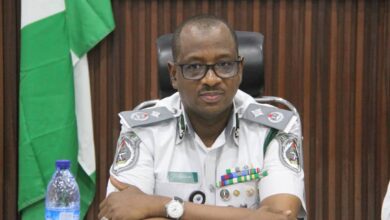
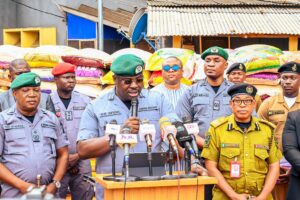 Deputy Comptroller Olukayode Oladapo Afeni, speaking in a JournalNG exclusive interview at the Idiroko border post, said the command’s recent run of seizures was not a miracle but the product of motivated officers, equipment from headquarters and “the right leadership” of Comptroller-General of Customs Bashir Adewale Adeniyi.
“What we are seeing is a result of the right leadership,” he said.
Ogun I covers one of the Service’s most difficult anti-smuggling theatres. Afeni, who took charge of the command in December 2025, said officers faced attacks in the early weeks of his posting.
The command’s response was not only more patrols. It went to traditional rulers and opinion leaders and argued that suppressing smuggling was in the communities’ own interest.
“That became our strategy for bringing everybody on board,” he said.
Asked whether Customs had recorded fatalities, he was blunt: “No, no casualty.” Officers have been in minor accidents and confrontations, he added, “but even at that, we are not deterred. Our morale for service is renewed every day.”
Joint operations, not just Nigerian patrols
Cooperation with Beninese counterparts and other Nigerian agencies, he said, has been “superb, very superb.” The command has mounted joint shows of force and joint operations across the frontier.
“Ogun State is an example of how government institutions should work and cooperate because we are working towards the same goal, whether for the sub-region or the national government,” Afeni said. “It is for the betterment of our people, and so we are on the same page.”
From foot patrols to geofencing and drones
Afeni rejected the idea that the command still runs a manual operation.
“We have left manual operations behind. The Nigeria Customs Service is the most automated government agency today and we are moving into critical areas of enforcement using geofencing, geospatial technology, deployment of drones and more.”
Day-to-day, he said, the command still leans on the Customs Intelligence Unit and sister agencies. “That is why you see that we are a step ahead of these bad guys.” Those tools, he added, are deliverables of the Service’s Trade Modernisation Project.
Sports, a jetty and a school — the non-kinetic front

Enforcement, he said, cannot be force alone. Under the command’s corporate social responsibility programme, the Service is building a jetty and renovating a secondary school in Ijofin community. Sports and other youth programmes are meant to offer recreation and serve as a non kinetic alternative in the fight against smuggling.
“It is a way for us to tell them that they can make a living outside smuggling. That is why we are catching them young,” he said. “I can confirm that this is working.”
Legitimate trade is not frozen
Idiroko is not only a seizure point. Asked whether export trade happens through the border, Afeni said: “Yes, very seriously.”
The main commodities, he said, are compressed natural gas (CNG), white talc and crushed thermal coal, with free-on-board value running into the billions of naira every month.
The real enemy: terrain and an invisible line
The greatest operational problem, he said, is not only armed smugglers. It is the ground itself. Some patrol areas have no communications network. A location that is still inside Nigeria can take more than an hour to reach from Idiroko; in parts of the same local government, officers travel six or seven hours. When teams cannot talk to one another, response times collapse due to poor network.
The international boundary is another trap. According to him, the partitioning wasn’t properly done. The demarcation between Nigeria and Benin wasn’t properly done, so you may not even know which side you are on.”
A suspect fleeing in Nigeria can step into Benin in a few metres. Officers cannot shoot or apply force in a way that would become an incident of diplomatic concern.
“If, for example, a crime is happening around here now, it would be difficult for you to fire because you might fire into another country, and that becomes a diplomatic issue,” he said.
“So, those are the issues. There is no clear demarcation as to where Nigeria ends and where the other country starts, but we are managing it.”
He faces threats “every day. ”Ember months: demand will rise, so will the pressure
Afeni said the command is preparing for the usual late-year spike. Weddings, burials, festivals and Christmas raise demand for rice, fuel, textiles and other goods that smugglers try to push across the line.
“This is not the first time. We know how to separate the wheat from the chaff. We are up to the task. We will do what we have to do, and we will continue to do it.”
‘Work and pray’
Asked who he is beyond the uniform, Afeni described himself as “a simple person who relies on God.”
“In life, I take one step at a time. I work hard and pray, in that order. ‘Work and pray’ is my personal motto.
I believe you cannot work alone, and you cannot produce alone; both must work together.” That, in his telling, is also the method on the frontier: pressure on the bush paths, patience with neighbours on both sides of an unmarked line, and the knowledge that the next convoy will come whether or not the last one was stopped.
Read the full interview at www.journalng






The VIP perks on this site are actually legit. I feel like a valued player here and the customer support is super helpful. You should give 96xbajeevip a shot!