


The Managing Director of Inland Containers Nigeria Limited (ICNL), operators of the Kaduna Inland Dry Port (KIDP), Omotayo Philip Dada, has outlined an ambitious vision to reposition the company as an integrated logistics provider while unlocking the vast trade and export potential of Northern Nigeria.
In this interview with Ismail Aniemu, Dada speaks on the future of Kaduna Inland Dry Port, the ongoing institutional transition of Inland Dry Ports, the need for reliable rail freight between the seaports and the North, export diversification, the impact of naira depreciation on logistics, and ICNL’s ambition to build sustainable logistics corridors beyond Nigeria.
He also explains why he believes the future of Nigeria’s ports lies not merely in smarter seaports, but in integrated “smart logistics corridors” linking vessels, ports, rail, roads, inland terminals, exporters and final consumers.
Q: You took over as MD in 2024 after Ismail Yusuf’s long tenure. What is your immediate strategic priority for ICNL, and how do you intend to build on the company’s transformation of northern logistics without losing operational continuity?
I was privileged to inherit a company with more than four decades of experience, strong institutional knowledge and an established presence in Nigeria’s logistics industry. So, for me, leadership did not begin with changing everything; it began with understanding what had worked, preserving the strengths of the business and determining where we needed to evolve.

My immediate priority has therefore been continuity with transformation.
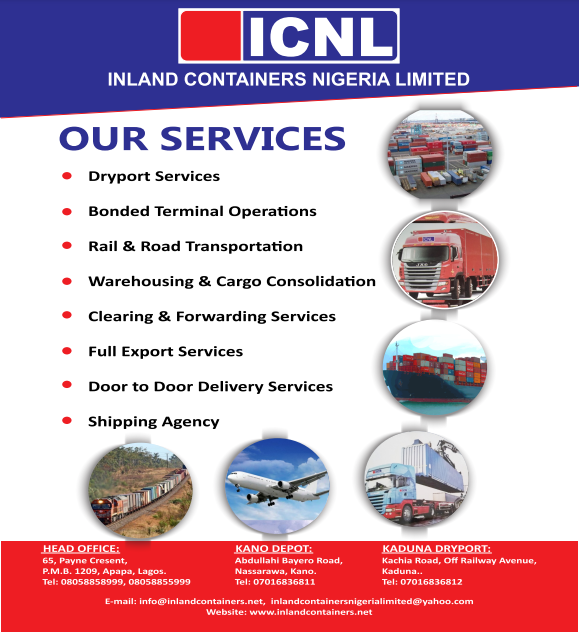
We are strengthening operational excellence and customer service while gradually repositioning ICNL from being perceived primarily as a terminal operator into a more integrated logistics company covering terminal operations, freight forwarding, road haulage, export logistics, warehousing, technology and, importantly, rail connectivity.
We are also giving significant attention to the commercial development of Kaduna Inland Dry Port, which ICNL operates, and to the broader opportunity presented by Northern Nigeria’s trade and export potential.
The objective is not to lose the institutional strengths that brought ICNL this far. It is to build on them—strengthening execution, developing our people, deepening customer relationships and positioning the company for the next generation of logistics.
Q: The Federal Government recently directed that Inland Dry Port functions be moved from the NSC to the NPA. What are your expectations under the new regime?
We welcome the development and see it as another important step in the continuing evolution of Nigeria’s port and logistics sector.
The Inland Dry Port programme has come a long way, and we must acknowledge the important role played by the Nigerian Shippers’ Council in nurturing the concept and working with concessionaires over the years. Kaduna Inland Dry Port itself emerged from that framework and became Nigeria’s first Inland Dry Port. The current institutional transition provides an opportunity to build further on that foundation.
As we enter this new phase, we are optimistic about the opportunities that closer integration with the Nigerian Ports Authority could create. NPA occupies a central position within Nigeria’s port system, and we believe that bringing Inland Dry Ports into closer alignment with the seaports can further strengthen the original vision of taking port services closer to businesses and communities in the hinterland.
For us at ICNL, as operators of Kaduna Inland Dry Port, our expectation is ultimately about connectivity and integration, stronger relationships with shipping lines, more effective through Bills of Lading (TBL) to Inland Dry Ports, reliable rail connectivity, improved positioning of empty containers for exporters, and seamless movement of cargo between the seaports and the hinterland.
We would like to see a situation where a container destined for Kaduna is increasingly treated as part of one integrated logistics journey, from the vessel to its final inland destination, rather than as separate stages of movement.
We are equally encouraged by the emergence of NPERA as the economic regulator. Clear institutional responsibilities and strong collaboration among NPA, NPERA, relevant regulators, NRC, shipping lines, terminal operators and Inland Dry Port operators can strengthen confidence in the sector.
Ultimately, I believe we all share the same objective: to make Nigeria’s logistics system more efficient, competitive and better connected.
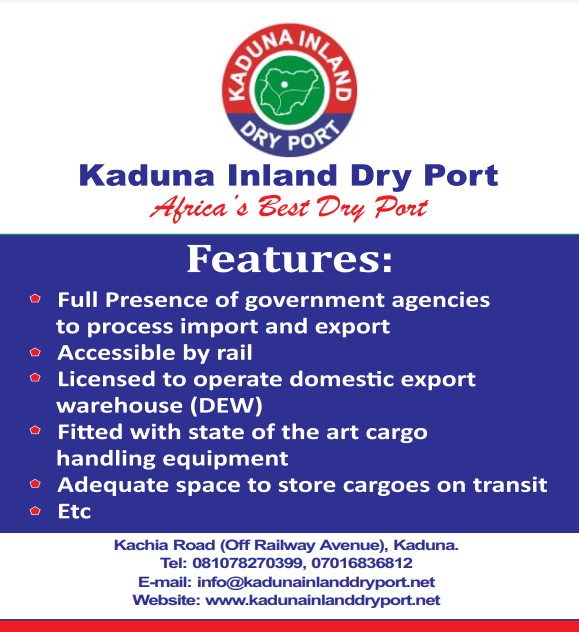
For Kaduna Inland Dry Port, success will be when its designation as a Port of Origin for exports and Port of Final Destination for imports is fully reflected in the everyday experience of the customer.
That, for me, would be a very positive outcome of this new phase.
Q: Kaduna Inland Dry Port is often described as Nigeria’s first fully operational dry port. What volume and mix of cargo is KIDP handling now, and what still prevents it from operating closer to full capacity?
Kaduna Inland Dry Port occupies a very important place in Nigeria’s logistics history as the country’s first Inland Dry Port, and ICNL is proud to be its operator.
Our cargo base has historically been predominantly containerised imports, supported by warehousing, cargo-clearance processes, haulage and other logistics services. At the same time, we are deliberately developing the export side of the business around the enormous productive capacity of Northern Nigeria, particularly agricultural commodities and, increasingly, opportunities for processed and value-added products.
We see considerable potential around commodities such as sesame, ginger, hibiscus, soybeans, groundnuts, and other agricultural and mineral products.
While throughput remains an important measure of performance, I believe the bigger conversation is how we collectively unlock the significant capacity and economic potential that already exist at KIDP.
That will require continued progress in rail connectivity and frequency, shipping-line participation, empty-container positioning, cargo aggregation, road infrastructure and seamless documentation between the seaports and the hinterland.
These are not challenges for one institution to solve alone. They represent opportunities for deeper collaboration across the logistics ecosystem.
For our part, ICNL continues to strengthen customer engagement, export cargo development, shipping-line relationships, operational readiness and partnerships that can help increase utilization of KIDP.
Q: High road-haulage costs from Lagos to the North have long squeezed importers and ICNL’s margins. How close is a reliable, regular rail container service from Apapa to Kaduna and Kano, and what would a 50–100 TEU-per-day rail lift change for your customers and for the naira?
Rail is one of the most important pieces of the Inland Dry Port equation, particularly for long-distance cargo movement. But I think it is important to make one point very clear: the development of rail should not be viewed as rail versus road haulage. The two should complement each other.
Nigeria is a large economy with significant cargo movement requirements, and what we need is a genuinely multimodal logistics system.
Rail is particularly suited to moving larger volumes over long distances, while road haulage provides the flexibility required for first-mile and last-mile delivery, as well as locations not directly connected to the rail network.
There is also room for different customer propositions. Some customers may require a premium, time-sensitive road service, while others may prefer a more economical scheduled rail option. A strong logistics system should be capable of providing both.
In fact, efficient rail connectivity can create opportunities for the haulage industry rather than eliminate them. Containers arriving by rail at Kaduna or Kano still need to move to factories, warehouses, distribution centres and customers across the region. Similarly, export cargo must first move from farms, factories and warehouses to the Inland Dry Port.
Road haulage therefore remains an essential part of the first-and-last-mile connection.
So, from ICNL’s perspective, the conversation should not be about replacing trucks with trains. It should be about using each mode where it is most efficient and connecting them properly.
We are encouraged by the renewed attention being given to rail freight and the growing engagement among NRC, terminal operators and private logistics companies.
Our aspiration is to build on that progress towards a predictable, commercially sustainable and scheduled container service connecting the seaports with the Northern logistics corridor.
I would be cautious about putting a specific commencement date on a regular Apapa-Kaduna/Kano service because achieving that requires the alignment of several stakeholders.
However, a sustained 50 to 100 TEU daily rail lift would be transformational. It would give customers greater choice, improve cargo predictability and container turnaround, support more efficient use of our road infrastructure and strengthen the economics of moving cargo between the ports and Northern Nigeria.
The export dimension is equally important. Northern commodities can be aggregated, processed and containerised inland, moved efficiently over the long distance by rail, and supported by road haulage at both ends of the journey.
That is the model I believe Nigeria should be working towards:
Rail for scale, road for reach, and both working together for the customer.
When we achieve that integration, we improve the competitiveness of Nigerian businesses, strengthen exports and ultimately support foreign-exchange generation.
Q: ICNL has argued that Nigeria’s economy needs both FX injection and rail for cargo. From a dry-port operator’s seat, what specific policy steps would most quickly reduce the cost of moving containers inland and support export diversification?
I believe considerable progress can be achieved by continuing to strengthen four areas.
First is predictable multimodal transportation. Rail should provide an efficient long-haul option, while road haulage continues to provide the flexibility, first-mile and last-mile connectivity required by customers. The objective should be integration rather than competition between modes.
Second is deeper integration between the seaports and Inland Dry Ports, so that documentation, regulatory processes, cargo clearance and tracking increasingly function as one logistics process.
Third is the positioning of empty containers closer to export-producing regions. Northern Nigeria has substantial exportable commodities, and bringing containers closer to those commodities can improve the economics of exports considerably.
Fourth is continuing to strengthen the broader export ecosystem, aggregation, certification, packaging, warehousing, inspection, finance and transportation.
The encouraging thing is that many of the building blocks already exist. What is required is increasingly connecting them.
The Inland Dry Port should therefore be viewed not simply as a cargo-handling facility, but as an important component of Nigeria’s trade infrastructure and export-development architecture.
Q: How is ICNL using KIDP and its bonded-terminal network to support SME exporters, agro-commodities and programmes such as NEPC’s DEW, and what is still missing in the export value chain?
Exports are a very important part of our strategy.
ICNL is leveraging KIDP, which we operate, alongside our broader terminal and logistics capabilities to bring export services closer to producers, aggregators and SMEs in Northern Nigeria.
The idea is straightforward: rather than an exporter moving goods all the way to Lagos before beginning the formal logistics process, an inland facility can support aggregation, storage, consolidation, documentation, inspection, container stuffing and other pre-shipment activities closer to the source.
For an SME, this can be particularly important.
A small exporter may have an excellent product but insufficient volume to fill an entire container or negotiate international logistics independently. Aggregation and groupage provide an opportunity to combine compatible cargo and make international markets more accessible.
We are therefore looking at the whole ecosystem, not merely the container movement.
But the longer-term opportunity goes further. Nigeria should progressively move from exporting predominantly primary commodities towards exporting more processed and value-added agricultural and mineral products.
If we can combine the productive capacity of Northern Nigeria with efficient logistics, standards, finance and greater value addition, the economic impact can extend well beyond the port itself.
Q: You have said a “smart port” that is not linked by rail and cargo visibility to Inland Dry Ports is incomplete. What digital and operational integrations are you putting in place between Lagos seaports and KIDP, and what should government and terminal operators do next?
Technology is increasingly central to modern logistics, but I believe we need to think about digitalization from the customer’s perspective.
For the customer, the logistics journey does not end at the seaport gate.
At ICNL, we are strengthening our systems to improve cargo visibility, documentation, container status, operational control, transport planning and customer experience.
The larger opportunity is for the different parts of the logistics ecosystem to become increasingly interoperable: NPA, relevant regulators, shipping lines, seaport terminal operators, NRC, Inland Dry Ports, freight forwarders and cargo owners.
Government and industry have already taken important steps towards port automation and trade facilitation. The next phase should continue building connectivity between those systems so that information can follow the cargo throughout its journey.
A customer should ultimately be able to follow cargo seamlessly from vessel discharge through evacuation and inland movement to arrival, clearance and final delivery.
That is why I often say:
The future is not simply a smart seaport. It is a smart logistics corridor.
Q: ICNL was founded in 1980 to take port services to the hinterland. Where do you see the next inland depot or dry-port play—Kano expansion, the South-East, or another corridor—and what would make that commercially viable?
We remain interested in opportunities that can strengthen Nigeria’s logistics infrastructure, but our philosophy is that expansion should follow cargo economics, not simply geography.
Northern Nigeria remains strategically important because of its population, industrial activity, agricultural production and proximity to neighbouring markets.
Kano naturally remains important within that ecosystem. At the same time, Nigeria has several other corridors with significant logistics potential.
For ICNL, any new investment would have to demonstrate sustainable cargo volumes, proximity to industrial or agricultural production, road and rail connectivity, customer demand and an appropriate regulatory environment.
Our immediate priority is also to extract significantly greater value from the infrastructure and corridors where we already operate.
Over time, however, we want to continue developing an indigenous Nigerian logistics network capable of connecting major production and consumption centres to our ports and, where commercially viable, to regional West African markets.
We would rather build sustainable logistics corridors than simply accumulate locations on a map.
Q: How has naira depreciation and tight FX affected import volumes, customer behaviour and ICNL’s own pricing and working capital over the past year, and how have you kept service levels stable?
The macroeconomic environment has undoubtedly affected the logistics industry.
When foreign exchange becomes more expensive, businesses naturally review procurement decisions, inventory levels and the timing of imports. At the same time, logistics operators also experience pressure from fuel, equipment, tyres, spare parts, maintenance and other operating inputs.
These are realities that affect the entire value chain.
At ICNL, our response has been to focus on the things within our control: financial discipline, operational efficiency, working-capital management, customer engagement and revenue diversification.
We are developing other value-added services while continuing to protect the quality of our core operations.
One principle remains particularly important to us: difficult economic conditions should not become an excuse for poor customer experience.
In logistics, reliability is part of the product we sell.
Q: What is ICNL’s competitive edge against other inland terminals and freight forwarders in West Africa, and how do you intend to grow beyond Nigeria while remaining a fully indigenous operator?
I prefer to think about our competitive advantage in terms of what ICNL brings to the customer rather than what another operator may or may not have.
Our strengths are experience, infrastructure, institutional knowledge and a deep understanding of the Nigerian hinterland.
ICNL has been operating since 1980. Over that period, we have developed considerable knowledge of cargo flows, regulatory processes, ports, inland transportation and the needs of customers operating in a complex logistics environment.
We also operate Kaduna Inland Dry Port, which gives us an important platform for connecting Northern businesses with Nigeria’s maritime gateways.
Going forward, however, our competitive advantage must increasingly be integration—terminal operations, freight forwarding, road haulage, warehousing, export consolidation, rail partnerships and technology working together around the customer.
Beyond Nigeria, we see opportunities arising from regional trade and Nigeria’s relationship with neighbouring and landlocked markets. Any expansion, however, should follow customer demand and commercially sustainable trade corridors.
Being indigenous is something we value.
Our ambition is to demonstrate that a Nigerian logistics company can combine international standards with deep local knowledge, and ultimately compete successfully across the region.
Q: Looking two to three years ahead, what would success look like for ICNL and Kaduna Inland Dry Port—in TEUs, rail share, export mix and contribution to hinterland industrialisation—and what is the biggest risk that could derail that picture?
TEU growth will certainly remain an important measure of our progress, but success, for me, goes beyond one number.
For ICNL, I would like to see materially stronger throughput, a more diversified revenue base and a deeper integrated-logistics proposition.
For Kaduna Inland Dry Port, which ICNL operates, I would like exports to become a much more meaningful part of the cargo mix and rail to become a dependable and commercially significant component of cargo movement, working alongside road haulage within a truly multimodal system.
But perhaps the most important measure of success would be what happens outside the gates of the port.
I would like to see a manufacturer in Kaduna able to bring production inputs inland efficiently. I would like a farmer, processor or exporter elsewhere in Northern Nigeria to aggregate and move goods to international markets through KIDP. And I would like SMEs to have access to logistics infrastructure without needing to build an entire supply chain themselves.
That creates opportunities for warehousing, processing, manufacturing, aggregation, transportation, SMEs and employment throughout the hinterland.
Rather than identifying any single institution or issue as the biggest risk, I would say the challenge we must collectively continue addressing is integration.
Ports, railways, road haulage, regulators, shipping lines, terminal operators, exporters, importers and Inland Dry Ports are ultimately parts of the same logistics ecosystem. The closer those components work together; the more competitive Nigeria becomes.
And that is what success would look like to me: an integrated logistics system in which ICNL continues to grow as a leading indigenous logistics company and Kaduna Inland Dry Port develops into a true trade gateway for Northern Nigeria.






The slot variety here is insane. I love how the games load quickly without any glitches. Definitely my new go-to place for some fun spins at brasil777slots.
The APK installation was a breeze and the performance is top notch. Everything feels very responsive. Get the app at pkjjwinapk
I love how easy it is to navigate the site. Even for someone who is not tech savvy, it is a breeze to find everything. Truly a user friendly spot. See akunjplogin for a great time!