

Lower Import Tariffs: Relief for Buyers or New Challenge for Nigeria’s Auto Industry?

The Federal Government’s decision to reduce import duties and levies on vehicles has sparked fresh debate across Nigeria’s automotive industry, whether the policy will deliver cheaper vehicles for consumers or further weaken local vehicle manufacturing. Maria Yusuf Writes
Introduced under the 2026 Fiscal Policy Measures and implemented by the Nigeria Customs Service from July 1, 2026, the reforms are aimed at reducing the cost of importing vehicles, facilitating trade and making automobile ownership more affordable. The measures reduced the import levy on used vehicles from 15% to 5%, while the levy on brand new vehicles was cut from 20% to 10%. In addition, the government lowered the overall customs duty on fully built passenger vehicles from 70% to 40% depending on the vehicle category, while introducing a Green Tax of 2% to 4% which applies to certain higher-engine-capacity petrol vehicles (above 2,000cc). Electric vehicles, mass transit buses, and many smaller engine vehicles are exempted as part of efforts to encourage cleaner transportation. Factory built Compressed Natural Gas (CNG) vehicles and CNG conversion kits also continue to enjoy duty incentives in line with the government’s drive to expand gas powered transportation.
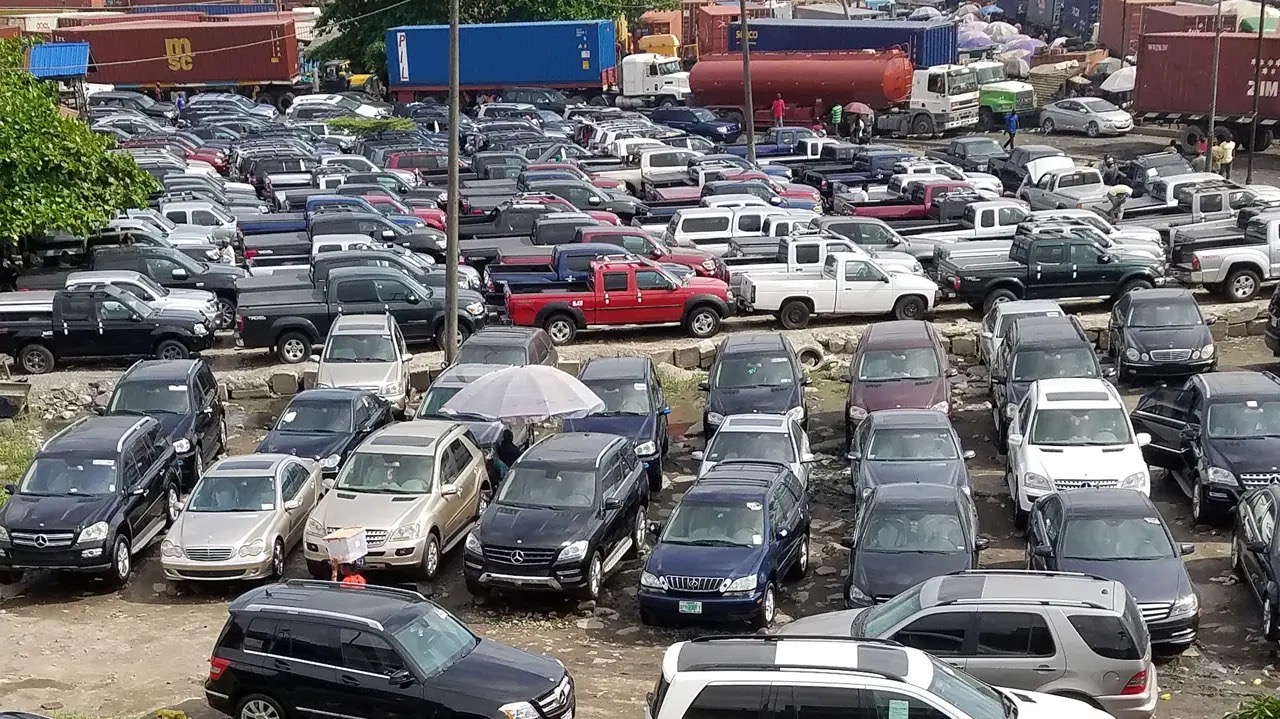
A visit to Berger Suya Auto Market, one of Lagos’ busiest hubs for imported vehicles, by JournalNG one month post the implementation of the revised vehicle tariff regime with objective of making automobiles more affordable, reveals that while the policy may have reduced one component of importation costs, the final price consumers pay is still being shaped by a combination of factors beyond Customs duties.
Dealers acknowledged that the reduction in import duties has had some effect on vehicle prices, but insist that the savings remain marginal when viewed against the overall cost of importing a vehicle into Nigeria.
According to findings at the market, Customs duty represents only one stage in the importation process. Before vehicles arrive at Nigerian ports, dealers must first purchase them abroad, transport them to shipping terminals, pay international freight charges and insurance, and contend with fluctuating exchange rates that significantly increase the landing cost.
Market operators explained that although some vehicle models have become slightly cheaper following the tariff adjustment, the reductions are not significant enough to transform the market. For instance, a foreign used Lexus RX 350 that previously sold for between ₦21.5 million and ₦22 million can now be found within the range of ₦18 million to ₦18.5 million, depending on the source of purchase, shipping costs and the dealer’s pricing structure.
Dealers stressed that pricing is not uniform because vehicles are sourced from different countries, auction platforms and dealerships abroad. Shipping costs also vary depending on the shipping line used, making it difficult to attribute vehicle prices solely to Customs charges.
Despite the moderate reduction in prices, traders at Berger Suya Auto Market say customer traffic has not improved significantly since the policy took effect. Rather than the tariff structure, they identified Nigeria’s prevailing economic conditions as the biggest obstacle to vehicle sales.
The situation, dealers say, has resulted in a sharp decline in vehicle sales compared with the same period last year. According to estimates by operators at Berger Suya Auto Market, sales performance, which stood at about 70% at H1 of 2025, has fallen to between 25 and 30% during the corresponding period in 2026.
The decline, they noted, reflects the impact of weakened consumer purchasing power despite the reduction in import duties. Although the tariff adjustment has led to a slight reduction in the prices of some imported vehicles, many Nigerians are still unable to afford them because of inflation, high exchange rates and the rising cost of living.
Beyond vehicle imports, the dealers contend that broader economic reforms capable of stabilising the exchange rate, reducing inflation and improving purchasing power would have a far greater impact on the automobile market than tariff reductions alone.

While importers see the policy as offering only limited relief under current economic realities, local vehicle manufacturers hold a more cautious view, warning that making imported vehicles cheaper could unintentionally weaken Nigeria’s efforts to build a sustainable automotive manufacturing industry.
To gain further insight into the concerns of indigenous manufacturers, we visited Innoson Vehicle Manufacturing’s Lagos showroom and service centre in Surulere, where a representative of the company, who requested anonymity because he was not authorised to speak on behalf of the company, expressed concern that reducing import duties on used vehicles could encourage more Nigerians to patronise imported automobiles at the expense of locally assembled brands.
The concern stems from what he described as a contradiction between the government’s industrialisation agenda and its fiscal policy. On one hand, successive administrations have consistently encouraged local vehicle production through the National Automotive Industry Development Plan and other initiatives designed to reduce Nigeria’s dependence on imported vehicles. On the other hand, the reduction in import duties on foreign used vehicles could make imported automobiles more attractive to buyers already constrained by limited purchasing power.
The representative, explained that the challenges confronting local manufacturers extend far beyond competition from imported vehicles. They noted that automobile assembly plants continue to grapple with volatile exchange rates, high lending rates, rising energy costs and the continued dependence on imported components and raw materials that are not yet available locally. Although some vehicle parts are produced within Nigeria, many critical components still have to be imported. As a result, fluctuations in the value of the naira continue to push up production costs, making it difficult for locally assembled vehicles to compete on price with imported alternatives.
He further observed that the high cost of borrowing in Nigeria places local manufacturers at a disadvantage, noting that manufacturers in several competing countries enjoy access to much lower interest rates, enabling them to produce vehicles at lower costs.
The representative also identified electricity as a major production challenge. They explained that automobile assembly requires uninterrupted power throughout the production process, forcing manufacturers to rely heavily on alternative energy sources whenever public electricity supply is inadequate. Combined with labour expenses, logistics costs and rising prices of production materials, these factors significantly increase the final cost of locally assembled vehicles.
Beyond production costs, he raised concerns over what they described as inconsistencies in government policy implementation and explained that although incentives and concessions are periodically introduced to support local manufacturing, different government agencies often interpret or implement the policies differently, creating uncertainty for businesses.
Despite these concerns, he maintained that Nigeria possesses the capacity to build a competitive automobile manufacturing industry if supported by consistent government policies, improved infrastructure, affordable financing and a more stable macroeconomic environment
While concerns persist over the implications of lower import tariffs for local manufacturing, another segment of the automotive industry believes the government’s fiscal incentives are already supporting the transition to Compressed Natural Gas (CNG) as a cleaner and more affordable alternative fuel.
To assess the impact of the policy on the country’s growing CNG ecosystem, we toured Black White Energy CNG conversion company, where the Business Development Manager, Mr. Peter Steven, explained that although the duty waiver does not eliminate the overall cost of importing CNG kits and equipment, it removes one of the financial burdens associated with importation. He noted that while the savings may appear modest, they have contributed to reducing the overall cost of conversion and have further encouraged the growing adoption of CNG across the country.
According to him, the minimum cost of converting a vehicle to CNG, which previously exceeded ₦1 million, has dropped to between ₦700,000 and ₦750,000, depending on the type of vehicle and the size of the cylinder installed. Steven disclosed that demand for CNG conversion has increased significantly over the past year. While Black White Energy previously converted an average of about 10 vehicles each month, the figure has risen to approximately 30 monthly conversions. Between January and July 2026, the company converted about 300 vehicles in Lagos and projects that the number could exceed 500 before the end of the year if the current momentum is sustained.

Business Development Manager
Black White Energy.
He attributed the growing demand largely to operators in the commercial transport sector, including ride-hailing drivers, logistics companies and other businesses that spend long hours on the road and are seeking to reduce operating costs. According to him, Toyota Corolla, Toyota Camry and Honda Civic models account for a significant proportion of the vehicles brought in for conversion because they are widely used for commercial transportation.
Despite the growing interest in CNG, Steven identified inadequate infrastructure as the biggest challenge confronting the sector. He explained that many motorists are willing to convert their vehicles but remain discouraged by the limited number of CNG refuelling stations across the country. He also noted that shortages of gas at some stations sometimes delay the testing of newly converted vehicles before they can be delivered to customers.
Beyond infrastructure, Steven said the company is also grappling with the challenge of sourcing replacement components for CNG kits. Since most kits are imported as complete units, replacing a faulty component often requires removing parts from a new kit. To address this challenge, Black White Energy plans to establish a dedicated inventory of spare components to strengthen after sales support as the number of converted vehicles continues to increase.
He further advocated greater government investment in CNG infrastructure and financing, noting that expanding refuelling stations across the country and improving access to funding for conversion centres and fleet operators would accelerate adoption and make cleaner transportation more accessible to Nigerians.
While the reforms have created new opportunities, they have also underscored the reality that lower tariffs alone cannot transform Nigeria’s automotive industry. The true measure of success will lie in the government’s ability to complement the policy with broader economic reforms that support local manufacturing, improve infrastructure, stabilise the business environment and ultimately make vehicle ownership more accessible and affordable for Nigerians.







One Comment