
INTERVIEW: Technology, Increased Compliance Contributing to Customs Efficiency at Apapa Port – Comptroller Oshoba

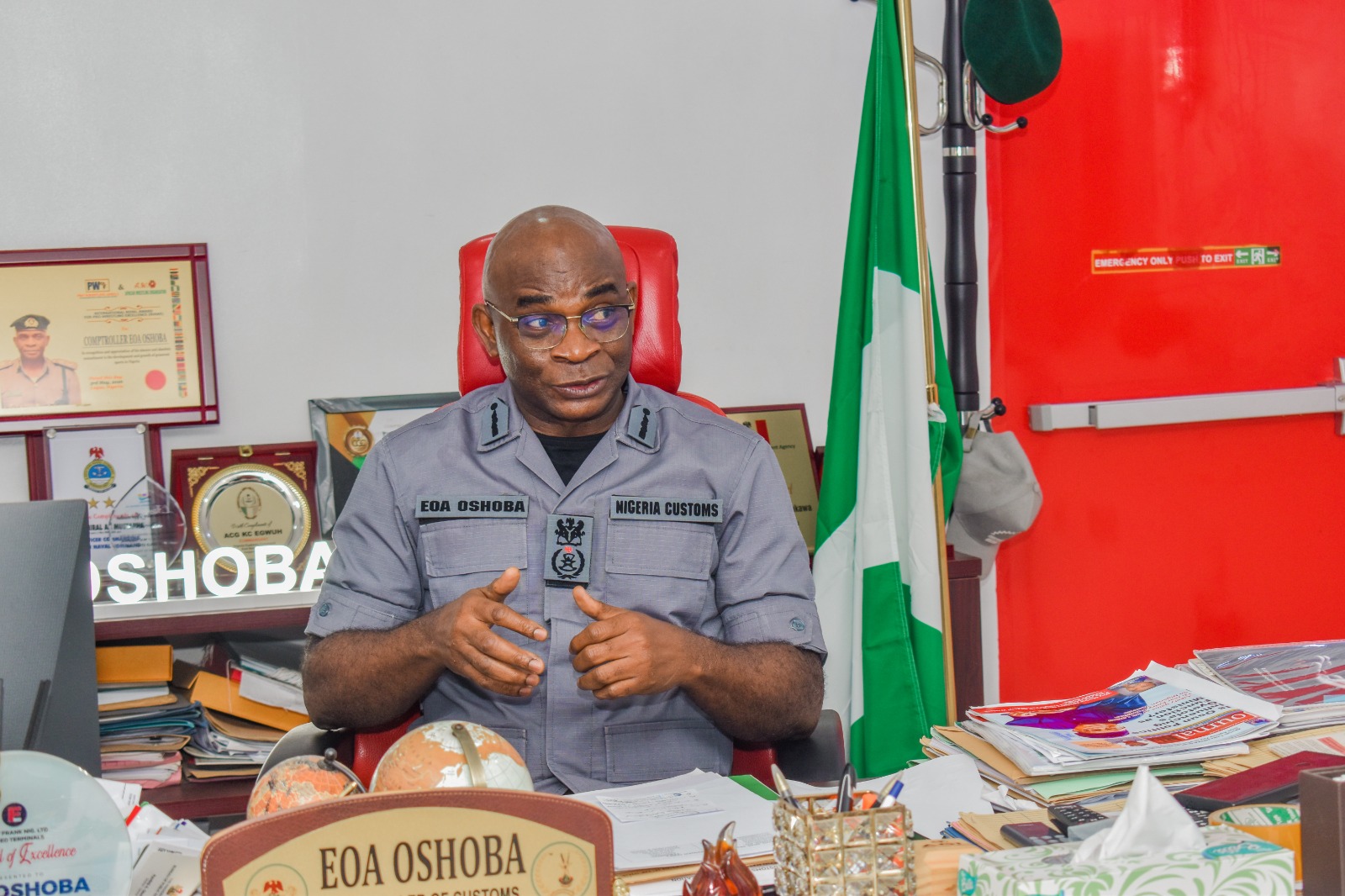
At the helm of the Nigeria Customs Service (NCS), Apapa Area Command, Comptroller Emmanuel Oshoba is overseeing one of the country’s most strategic and busiest gateways for international trade at a period of growing emphasis on revenue generation, trade facilitation, technology and border enforcement.
In this exclusive interview with Ismail Aniemu, Comptroller Oshoba speaks on the Command’s revenue performance, seizures, the deployment of technology, the B’Odogwu platform, the National Single Window, drive-through scanning, stakeholder compliance, inter-agency collaboration and efforts to address congestion along the port corridors.He said scanning now accounts for 65% of cargo inspection at the port. He also reflects on his more than three decades of service, the experience gained across different Customs departments and how he hopes to be remembered at the end of his assignment at Apapa.
Excerpts
Give us an overview of the command’s activities this year, particularly revenue generation, seizures, trade facilitation and the use of technology in customs operations.
In terms of revenue, the command is doing very well. As we speak, compared to last year, we are performing far better than we did at this time last year.
A major pointer to this is our performance in July. At the end of July, we recorded a N323 billion in revenue for the command. On a particular day, within 24 hours, we also recorded N28 billion. These are significant achievements.
So, compared to last year, we are doing far better this year in terms of revenue.
In terms of enforcement, it has also been much better this year. You may recall that the Comptroller-General of Customs was here recently for a media briefing on some of the seizures made by the command.
Some of these seizures include the influx of Canadian loud, expired pharmaceuticals, food and drinks. When the Comptroller-General was here, we handed some of the seized items over to NAFDAC and the NDLEA.
Some of the consignments handed over to the NDLEA were recently destroyed in the presence of the Chairman and Chief Executive Officer of the NDLEA, Brig. Gen. Mohamed Buba Marwa, and the Comptroller-General of Customs.
As we speak, we already have some other seizures. Sooner than later, we expect the Comptroller-General to come around again for another press briefing and to hand over the seized items to the relevant agencies.

So, in terms of enforcement, particularly intelligence-led enforcement, we are doing very well in the command.
On trade facilitation, there has also been significant improvement. This has been largely driven by the modernisation tools we now have.
B’Odogwu is now working optimally. Initially, we had some issues with the system, but it is now functioning optimally and making operations much easier.
Nationwide, the number of beneficiaries under the Authorised Economic Operator (AEO) programme has also increased. As of last year, we had about 120 beneficiaries. As we speak, we have more than 200 AEO beneficiaries. This has greatly facilitated trade within the command.
How has the command fared in non-intrusive inspection following the deployment of the drive-through scanner at Apapa Port?
Non-intrusive inspection has also helped us tremendously in trade facilitation and ease of doing business. As you know, the drive-through scanner can scan about 200 containers per hour. As we speak, Apapa is proud to say that we are now doing what we call universal scanning.
This means that all consignments coming into Apapa are scanned, even before they are sent to the various terminals. We therefore have a record locally and another record at headquarters for audit purposes. We are able to process these consignments here, and where there is a need for an audit, headquarters also has a record.
What this has done is to increase the ratio of scanning compared to physical examination. Previously, I think the ratio was about 70 per cent physical examination to 30 per cent scanning. Now, scanning has increased to almost 65 per cent, while physical examination is about 35 per cent. That is a significant improvement. It has aided trade facilitation and ease of doing business.
What has been the level of support you have enjoyed from sister government agencies?
I must acknowledge that the support has been tremendous. There is a saying that the head directs the movement of the body. The collaboration at the top, particularly between the Nigeria Customs Service, led by our Comptroller-General, Bashir Adewale Adeniyi, and the NDLEA, led by Brig. Gen. Mohamed Buba Marwa, has improved inter-agency collaboration. I just talked about the handover of seized consignments. It starts with intelligence.
Much of the intelligence that has led to seizures here has also been provided through the NDLEA. We also have international intelligence agencies that provide information to both the NDLEA and the Customs Service. We have worked collaboratively to make these seizures. So, many of the seizures involving Canadian loud and other prohibited items have been joint efforts.
This is largely based on the Memorandum of Understanding (MoU) between the Nigeria Customs Service and the NDLEA. A similar arrangement exists between Customs and NAFDAC. This has greatly supported our activities here in the command.
The behavioural pattern of stakeholders is also important to this interview. On a scale of zero to 100, what is your assessment of stakeholder compliance?
When I first arrived here, I would have put stakeholder compliance at about 60 per cent. As we speak, I think it is above 80 per cent. What has contributed to this improvement is the B’Odogwu system and the non-intrusive inspection system we have been talking about. They have made it necessary for declarations to be clean. Therefore, the level of compliance has to improve.
The National Single Window has also helped to improve compliance because declarations must now be clean and clear. There is no room for manipulating documents, submitting fake documentation or engaging in other irregularities. So, the level of compliance is improving.
With the return of slow traffic along the port corridors, there are concerns that congestion could worsen due to the slow exit of cargo from the port. How are you managing this?
Let me start by saying that this is something I met when I first arrived here. In collaboration with the port manager, we swung into action to clear the port corridor. I am also happy to report that the Presidential Enabling Business Environment Council (PEBEC) has helped us in this regard. On more than two occasions, they have come here to assist us in clearing the port corridor. So, the efforts of the Customs Service, the port manager and the PEBEC team have helped us tackle the problem.
With the coming of the National Single Window, how is the Apapa Command adapting to the system?
Like the Comptroller-General and the National Single Window Committee acknowledged, we initially had some hiccups because the uploading of documents from agencies such as NAFDAC was somewhat burdensome.
However, the service has been at the forefront of efforts to resolve these challenges. Our ICT unit at headquarters is actively involved with the National Single Window. As I speak, those hiccups are no longer there. There is now a free flow of document uploads through the National Single Window in conjunction with B’Odogwu.
There is now proper streamlining of activities between the National Single Window and B’Odogwu. So, we no longer have those challenges.
As an officer who has spent about three decades in the service and worked in different departments, including intelligence, and who is now overseeing Customs activities at one of the busiest ports in Western and Central Africa, what would you like to be remembered for in this assignment?
First and foremost, I want to say that Customs has several departments and areas of responsibility, from revenue to enforcement, excise and intelligence. They are all interwoven.
The experience you gain from all these areas helps you perform better and optimally wherever you find yourself. As someone who has been in the service for more than 34 years, my experience in the various departments has helped to build me up and made it easier for me to tackle issues that come to my table.
Personally, I just want to be remembered as somebody who came, tried his best and, to the glory of God, is leaving better than he started.
What would you say has been your biggest challenge on this assignment?
It is the human element. The human element is unpredictable. You do not always get the best from people at the time you expect it. The human element determines the outcome of many of the things we do. We were talking about stakeholder compliance, for instance, and the human element always comes into play. So, I think that is the biggest challenge for me personally.





Wow, superb blog format! How lengthy have you ever
been blogging for? you made blogging glance easy. The overall look
of your website is magnificent, let alone the content material!
Visit my web blog nude kids photo
That is a very good tip especially to those new to the blogosphere.
Brief but very precise info… Many thanks for sharing this one.
A must read article!
Also visit my webpage … free child sex videos