


…Says Seamless Rail, Through Bills of Lading Needed for Efficiency
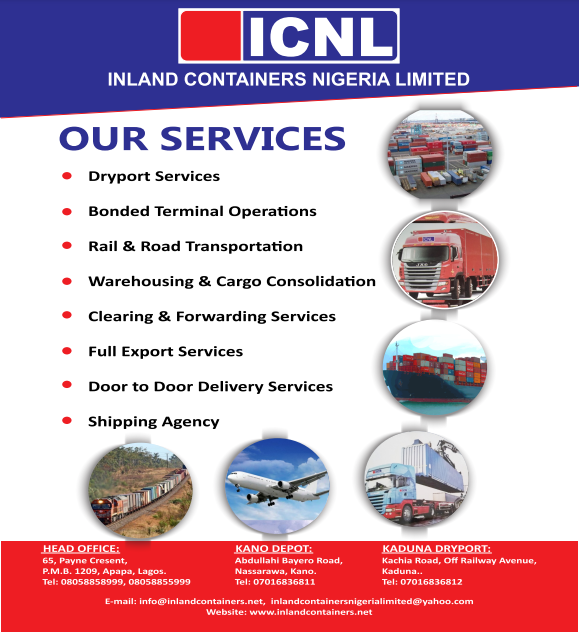
The Managing Director of Inland Containers Nigeria Limited (ICNL), Omotayo Philip Dada, has backed the Federal Government’s decision to transfer Inland Dry Port functions from the Nigerian Shippers’ Council (NSC) to the Nigerian Ports Authority (NPA), describing the shift as a chance to bind seaports more tightly to hinterland terminals.
Dada welcomed the new regime because NPA sits at the centre of Nigeria’s port system. Closer alignment, he argued, would advance the original idea of taking port services nearer to businesses in the hinterland.
“Our expectation is ultimately about connectivity and integration, stronger relationships with shipping lines, more effective through Bills of Lading (TBL) to Inland Dry Ports, reliable rail connectivity, improved positioning of empty containers for exporters, and seamless movement of cargo between the seaports and the hinterland,” he said.
He added that a container bound for Kaduna should be treated as one logistics journey—from vessel to final inland destination—rather than a chain of disconnected stages. Success for Kaduna Inland Dry Port (KIDP), which ICNL operates and which is widely regarded as Nigeria’s first fully operational dry port, would come when its status as a Port of Origin for exports and Port of Final Destination for imports is felt in everyday customer experience.

He also noted the emergence of NPERA as economic regulator and called for clear roles and collaboration among NPA, NPERA, the Nigerian Railway Corporation (NRC), shipping lines, seaport terminals and dry-port operators.
Continuity with transformation
Dada said he inherited more than four decades of institutional knowledge and had no intention of dismantling what already worked. His immediate priority, he said, is “continuity with transformation”: keeping operational excellence and customer service while repositioning ICNL from a terminal operator into an integrated logistics company covering terminal operations, freight forwarding, road haulage, export logistics, warehousing, technology and rail connectivity.
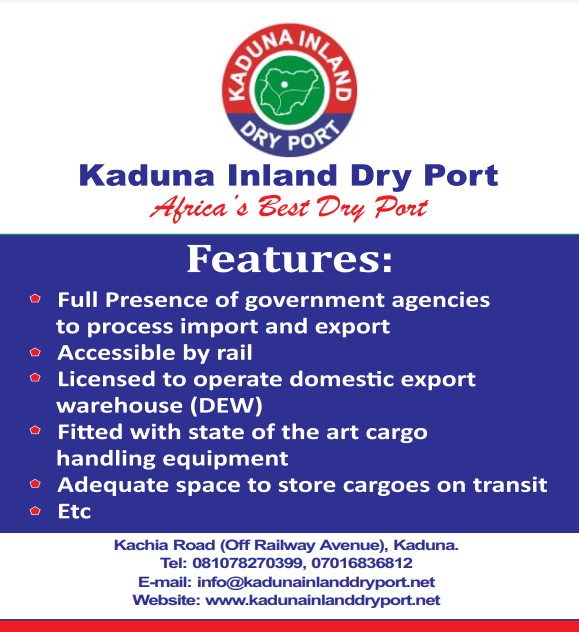
Commercial development of KIDP and Northern Nigeria’s trade and export potential sit at the centre of that shift.
Cargo mix and unused capacity
KIDP’s historic cargo base has been predominantly containerised imports, supported by warehousing, clearance, haulage and related services. ICNL is now pushing the export side around Northern agricultural and mineral commodities—sesame, ginger, hibiscus, soybeans, groundnuts and others—plus processed and value-added products.
Throughput remains a performance measure, Dada said, but the larger task is unlocking capacity already on the ground. That requires progress on rail frequency, shipping-line participation, empty-container positioning, cargo aggregation, road infrastructure and seamless documentation between seaports and the hinterland. Those, he stressed, are ecosystem problems, not the burden of a single operator.
Rail for scale, road for reach
High road-haulage costs from Lagos to the North have long squeezed importers and operators’ margins. Dada rejected a “rail versus trucks” framing. Nigeria needs a multimodal system in which rail moves large volumes over long distances and road handles first- and last-mile delivery and locations off the rail network.
A sustained 50–100 TEU daily rail lift from Apapa to Kaduna and Kano would be “transformational,” he said—improving choice, predictability, container turnaround and the economics of northbound cargo while still leaving haulage work at both ends of the journey. He declined to name a start date for a regular scheduled service, saying it depends on alignment among NRC, terminals and private logistics firms.
The same model, he added, would help Northern commodities be aggregated, processed and containerised inland, moved by rail over the long haul, and supported by trucks at origin and destination—strengthening exports and foreign-exchange generation.
Policy steps that would cut inland costs
From a dry-port operator’s seat, Dada listed four priorities: predictable multimodal transport; deeper integration of documentation, clearance and tracking between seaports and Inland Dry Ports; empty containers positioned closer to export-producing regions; and a stronger export ecosystem of aggregation, certification, packaging, warehousing, inspection, finance and transport.
The Inland Dry Port, he said, should be treated as trade infrastructure and export-development architecture, not merely a cargo-handling yard.
SMEs, agro-exports and the missing links
ICNL is using KIDP and its bonded-terminal network to bring aggregation, storage, consolidation, documentation, inspection and stuffing closer to producers and SMEs so they do not have to start the formal logistics process only after goods reach Lagos. Groupage can help smaller exporters who lack a full container load.
The longer-term prize, he said, is moving Nigeria from primary commodities toward processed and value-added agricultural and mineral exports, combining Northern productive capacity with logistics, standards and finance.
A smart corridor, not only a smart seaport
Dada repeated that a “smart port” unlinked by rail and cargo visibility to Inland Dry Ports is incomplete. ICNL is strengthening systems for visibility, documentation, container status, operational control, transport planning and customer experience. The next industry step, he said, is interoperability so information follows cargo from vessel discharge through evacuation, inland movement, clearance and final delivery.
“The future is not simply a smart seaport. It is a smart logistics corridor.” he said.
Founded in 1980 to take port services inland, ICNL remains interested in new depots, but Dada said expansion must follow cargo economics, not a map. Northern Nigeria—population, industry, agriculture and neighbouring markets—remains strategic; Kano stays important. Any new site would need sustainable volumes, production proximity, road and rail links, demand and a workable regulatory setting. Immediate focus is extracting more value from corridors ICNL already serves, with an eye on commercially viable West African connections.
Dada added that Naira depreciation and tight foreign exchange have forced importers to rethink procurement, inventory and timing, while operators face higher costs for fuel, equipment, tyres, parts and maintenance. ICNL’s response has been financial discipline, efficiency, working-capital control, customer engagement and revenue diversification. Difficult conditions, Dada said, “should not become an excuse for poor customer experience.”
He framed ICNL’s advantage as experience since 1980, knowledge of hinterland cargo flows and operation of KIDP, increasingly packaged as an integrated offer—terminals, forwarding, haulage, warehousing, export consolidation, rail partnerships and technology.
Success in two to three years, he said, would be stronger throughput, a more diversified revenue base, a larger export share at KIDP, and rail as a dependable part of a multimodal system. The more important test lies outside the gate: a Kaduna manufacturer able to bring inputs inland efficiently; a Northern farmer or processor able to reach international markets through KIDP; SMEs able to use logistics infrastructure without building an entire supply chain.
The biggest risk, in his view, is not one institution but incomplete integration. Ports, railways, haulage, regulators, shipping lines, terminals, exporters, importers and dry ports are parts of one system. The closer they work, the more competitive Nigeria becomes—and the closer KIDP comes to being a true trade gateway for the North.







Solid platform with a huge variety of games. I appreciate the transparency and the quick deposit options. Five stars from me! bdvb88
Everything is well organized and the gaming experience is top notch. It is a very reliable place for anyone looking for excitement. Visit vnhitclubinc