


The Customs Officers’ Wives Association (COWA), Tin Can Port Command Chapter has called on Nigerians to prioritise cancer awareness and early detection, particularly of breast and cervical cancers, as it intensified efforts to educate the public on preventive healthcare.

The call was made on Thursday, October 15, 2026, during a cancer awareness walk organised by the association from Tin Can Customs to Liverpool in Apapa, Lagos.

Addressing participants, COWA Chairperson, Mrs Caroline Ifeoluwa Anani, said the campaign is aimed at educating the public, particularly women, on the dangers of cancer and the importance of early detection in saving lives.
“Cancer is real. Early detection saves lives,” she declared, urging participants to spread the message within their families and communities.
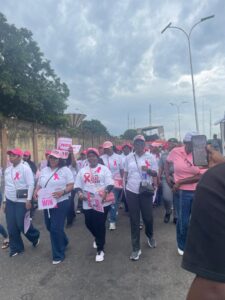
Anani explained that October, observed as Breast Cancer Awareness Month, provides an opportunity to intensify public education and encourage people to take their health seriously.
She stressed that cancer awareness should not be restricted to hospitals or medical professionals but should involve individuals, families, communities and government institutions.


The chairperson urged Nigerians to understand cancer risk factors, recognise possible warning signs and seek medical advice promptly when they notice unusual changes in their bodies.
She also called for greater support for people living with cancer, emphasising the need for collective action to improve access to screening and medical care.

According to her, government intervention through the provision of affordable or accessible cancer screening would help more people understand their health status and seek treatment early.

Anani further encouraged individuals and organisations to support cancer awareness initiatives and provide assistance to affected persons, noting that financial constraints should not prevent people from accessing necessary healthcare.

Beyond cancer education, Anani said the association’s activities are also focused on empowering women, restoring hope and encouraging them to recognise their value in society.
She explained that COWA’s decision to extend a hand of fellowship to members of the public, including the distribution of relief materials and incentives during the outreach, is part of its broader commitment to women’s empowerment.

According to her, the initiative is not intended to label beneficiaries as poor but to encourage them and demonstrate that they mattere and belong in the society.
“We are to empower women, to engineer them, to give them hope, to give them faith,” she said, explaining that acts of support and encouragement could strengthen women and improve their well-being.

Anani added that access to adequate food and proper nutrition is important for maintaining good health, while encouraging people to take responsibility for their physical well-being.
She also disclosed that the association is considering a future mental health awareness initiative to address issues affecting women, including depression and emotional distress arising from financial difficulties, unemployment and family challenges.
The chairperson stressed that women should be encouraged to believe in themselves, pursue their potential and seek support when facing difficult circumstances.
“Depression kills too,” she said, calling for increased awareness of mental health and greater efforts to prevent women from feeling isolated or sidelined by their personal and economic challenges.
She identified television, magazines, the internet and social media platforms, including TikTok, Facebook and Instagram, as important channels for reaching wider audiences with health and empowerment messages.
Anani also noted that cancer awareness should extend to men, pointing out that prostate cancer is an important health concern requiring attention.
She encouraged men to pay attention to changes in their bodies and seek medical advice when they notice unusual symptoms.
Also speaking during the awareness walk, medical expert Dr Chidinma Obialor provided information on breast and cervical cancers, explaining their warning signs, risk factors and available preventive measures.

Obialor noted that cancer is not a disease that Nigerians could dismiss as a problem affecting only other parts of the world, stressing that it remains a significant health concern in Nigeria and across Africa.
She explained that cancer develops when abnormal cells grow uncontrollably and may spread to other parts of the body if not detected and treated appropriately.
On breast cancer, the medical expert identified warning signs that women should watch out for, including a new lump or swelling, noticeable changes in breast size or shape, nipple inversion, skin changes and unusual nipple discharge.
She encouraged women to become familiar with the normal appearance and feel of their breasts so they could recognise changes that might require medical evaluation.
Obialor advised anyone who notice unusual changes to seek prompt medical attention rather than assume that a lump or growth is harmless.
She also highlighted mammography as an important screening tool for detecting breast abnormalities and emphasised that timely diagnosis could improve treatment outcomes.
The doctor further discussed factors that may influence breast cancer risk, including family history and obesity, encouraging women to adopt healthy lifestyle habits and follow appropriate screening recommendations.
Turning to cervical cancer, Obialor explained the link between human papillomavirus (HPV) infection and the disease, highlighting HPV vaccination as an important preventive measure.
She urged parents and guardians to seek HPV vaccination for eligible children and adolescents, noting that prevention and public education were essential to reducing the burden of cervical cancer.
The medical expert also advised women to seek medical evaluation for unusual vaginal bleeding, bleeding after sexual intercourse and persistent pain during intercourse, explaining that such symptoms should not be ignored.








One Comment