
Why Maritime Institutions in MOWCA Countries Must Aim to Gain from 100,000 Seafaring Jobs -Chilaka

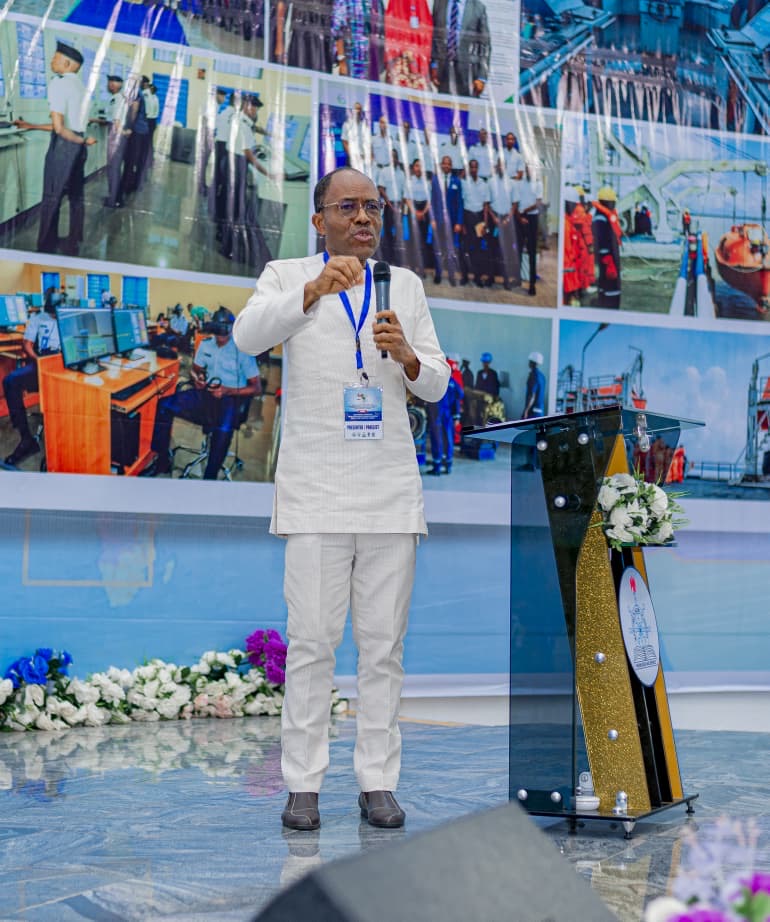
Dr. Edmund Chilaka,an adjunct lecturer at the University of Lagos has urged maritime education and training institutions across West and Central Africa to reposition themselves through strategic synergies if they must tap into the 100,000 vacant seafaring jobs across the world
Speaking at a Maritime Organisation of West and Central Africa (MOWCA) initiated exchange visit holding in Akwa Ibom, Chilaka urged that the training institutions should look beyond institutional boundaries while adhering to Ilinternational conventions like the Standards of Training, Certification and Watchkeeping for Seafarers (STCW 1978) and position the subregion as a competitive supplier of skilled seafarers to the global market.
While making a keynote presentation Chilaka who also doubles as a visiting lecturer at the Liverpool John Moores University, and Director of the Centre for Indigenous Maritime Trade and Transport Studies, said the initiative comes at a critical time as the global maritime industry faces a projected shortage of about 100,000 seafarers by 2026.
He warned that West and Central Africa remains poorly positioned to benefit due to fragmented training standards and limited access to sea time opportunities.
He noted that between 80 and 90 per cent of maritime trade in the region is controlled by foreign shipping lines, including MSC, Maersk Line, CMA CGM, Hapag-Lloyd, COSCO, and China Shipping, with no major indigenous carrier operating at international scale. This dominance, he explained, restricts cadets’ access to mandatory sea-time experience required for Certificates of Competency, creating a core structural challenge for maritime training in the region.
On cargo throughput, Chilaka highlighted Nigeria’s leading position with 140 to 160 million tonnes annually through Lagos, Lekki, and Onne ports, followed by Angola with 50 to 70 million tonnes, Côte d’Ivoire with about 30 to 35 million tonnes, and Ghana and Togo each handling roughly 25 to 30 million tonnes. Cameroon and Senegal process between 15 and 20 million tonnes each, reflecting the scale of maritime trade across the region.
Despite this volume, intra-regional trade under the African Continental Free Trade Area (AfCFTA) remains below seven per cent, a situation he described as a reflection of weak indigenous shipping capacity. He attributed this to structural constraints such as export-oriented trade systems, inadequate port infrastructure, low draft limitations, and limited cross-border trade liberalisation.
Chilaka identified the Regional Maritime University in Ghana, the Association Régionale de Sciences et Techniques de la Mer (ARSTM), and the Maritime Academy of Nigeria as key institutions driving the harmonisation effort, noting that all three already offer training programmes aligned around the Certificate of Competency framework in Nautical Science and Marine Engineering.
The harmonised curriculum is anchored on STCW minimum global competency standards and covers four key categories of maritime personnel: deck officers, marine engineers, ratings, and port management professionals, with additional emphasis on bilingual proficiency in English and French to serve the region’s diverse membership.
For deck officers, the curriculum standardises training in navigation, watchkeeping, cargo handling, ship stability, emergency response, GMDSS communications, and Bridge Resource Management, ensuring that officers at all ranks meet globally accepted operational and safety standards.
Marine engineering training is similarly standardised, covering engine operations and maintenance, electrical and automation systems, fuel management, environmental compliance under MARPOL, emergency response, and Engine Room Resource Management for effective technical supervision onboard vessels.

For ratings, the framework focuses on foundational seamanship and engine room skills, safety drills, equipment handling, and onboard communication, while port management training aligns with international standards set by IMO, UNCTAD, and the International Association of Ports and Harbours, covering logistics, maritime law, trade facilitation, port economics, and strategic management.
A major feature of the reform is the shift to competency-based training, where emphasis is placed on demonstrable skills rather than theoretical knowledge. Chilaka cited several IMO Model Courses guiding this approach, including those on simulator training, personal survival techniques, first aid, engineering competence, and seafarer assessment, all of which require practical demonstration of skills.
While institutions such as the Maritime Academy of Nigeria, Oron, and the Regional Maritime University already deploy simulators, practical drills, and digital training tools, Chilaka identified the persistent shortage of sea-time placements as the most critical challenge. He added that harmonisation would enable mutual recognition of certificates across countries, reduce training duplication, strengthen regulatory oversight, and improve the region’s ability to compete globally, while also enhancing collaboration and attracting international support for maritime development.
He called for a unified bilingual approach to maritime training while urging the institutions to prepare their cadets for English and French speaking capacities as an additional advantage in the global maritime ecosystem adding that proficiency in one language alone could be a inhibiting factor in the job market.
He disclosed that there are training and research funding grants that have not been utilised by institutions and urged them to identify and maximize the opportunities for expanded maritime scholarships




y3jbw7
5fmkg5