


By Ismail Aniemu
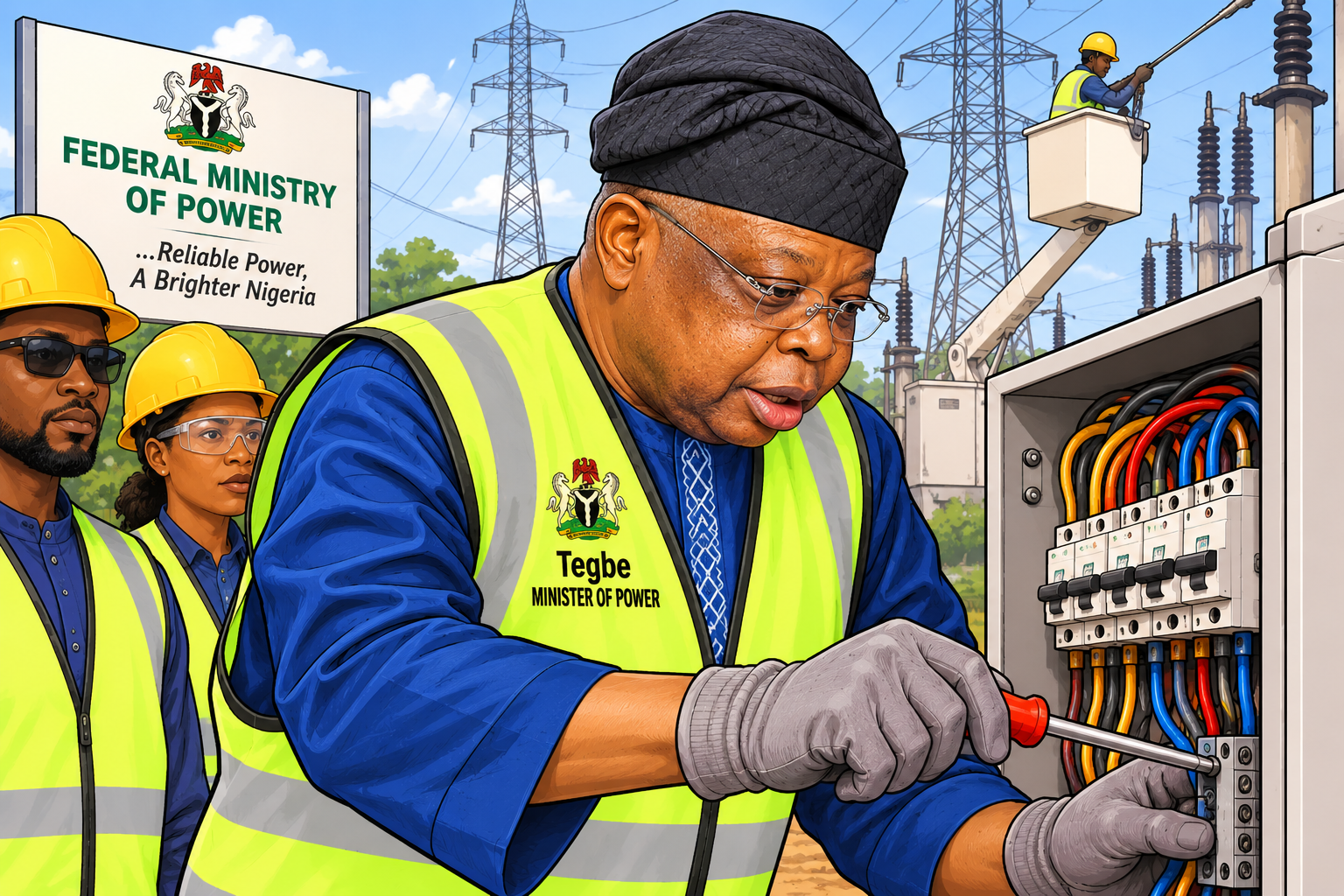
Joseph Olasunkanmi Tegbe, sworn in as Nigeria’s Minister of Power in June 2026 by President Bola Tinubu, stepped into one of the country’s most challenging portfolios expressing optimism despite battling challenges
Succeeding Adebayo Adelabu ,who resigned to pursue elective office, Tegbe—a civil engineer, former senior partner at KPMG Africa, and Director-General of the Nigeria-China Strategic Partnership—brought a reformist, execution-focused approach to a sector long plagued by grid instability, gas constraints, aging infrastructure, high losses, and liquidity shortfalls.
His stated goal is straightforward: reliable and affordable electricity for homes, businesses, and industries. In his early months, Tegbe emphasized diagnosis, stabilization, and measurable delivery over grand promises, acknowledging publicly that many Nigerians still lack consistent power and that “fixing this sector properly takes time.”
Early Stabilization and Infrastructure Gains
In his first 100 days (roughly June–September 2026), Tegbe’s team prioritized restoring stranded capacity and relieving transmission bottlenecks. Key actions included:
Revival of the 375 MW Alaoji open-cycle power plant after three years offline.
Major upgrades to Lagos transmission substations Apapa, Ijora, Alausa, and Lekki. These added hundreds of megawatts of transformation capacity ,reports cite roughly 672 MW unlocked across the sites through new transformers and feeders, with additional capacity later referenced in related corridors. A 300 MVA transformer at Katampe in Abuja added further capacity.
Accelerated metering under the Presidential Metering Initiative and related programmes, with about 350,000 meters installed in the first 100 days cumulative installations exceeding 1 million by August 2026. This aimed to reduce estimated billing, commercial losses, and disputes. Training of thousands of young Nigerians as smart-meter installers supported the rollout.
Generation periodically exceeded 5,000 MW in mid-2026 periods, though national averages remain constrained by gas supply, hydro variability, and distribution challenges.
Strategic Roadmap and Priority Corridors
By late October 2026, Tegbe outlined a four-pillar framework at the Nigeria Energy Leadership Summit: enhancing energy zones, strengthening sector liquidity and sustainability, optimizing existing assets, and expanding infrastructure for future demand.
Tegbe identified three priority economic energy corridors Lagos ,Ogun, Benin,Enugu,Port Harcourt, and Abuja,
Kaduna–Kano,to better align generation, transmission, distribution, and demand, supporting industrial productivity. Complementary efforts include continued work on the Distribution Sector Recovery Programme, loss reduction, and technical audits of aging infrastructure along key lines such as Benin–Egbin and others.
On the financial side, the government has paid ₦1.23 trillion toward an estimated ₦3.3 trillion in legacy sector liabilities while seeking to block new leakages. Tegbe has repeatedly stated there is no plan to raise electricity tariffs.
Longer-term ambitions include a proposed $2 billion East-West super grid to raise transmission capacity significantly targeting up to 19,000 MW capacity in related statements and stronger private-sector participation. Off-grid and renewable solutions via the Rural Electrification Agency, including solar mini-grids and projects such as a planned 200 MW solar initiative linked to industrial parks, form part of the access strategy. Engagement with Chinese partners emphasizes local capacity building alongside investment.
Battling Sabotage, Vandalism
In early November 2026, outages affected Lagos, the FCT, and other areas due to planned maintenance at Egbin, gas constraints, and transmission-line sabotage/vandalism. Tegbe communicated updates publicly, attributed causes transparently, and reported progressive restoration ,including confirmation of power returning to parts of Lagos such as Ajah, Lekki, Ikoyi, and others. He convened stakeholders on anti-vandalism measures, treating power infrastructure as a national security priority.
The ministry has also worked to clear long-stranded transmission equipment from ports e.g., 98 of 300 containers to complete stalled projects.
Challenges and Realistic Outlook
Progress has been incremental rather than transformative. Persistent issues—gas supply reliability, high technical and commercial losses often 30–40% at the distribution level, vandalism, liquidity pressures, and the gap between installed capacity (over 13,000 MW) and delivered power—continue to frustrate consumers. Some civil society voices have criticized the pace and called for greater accountability. Tegbe has responded by stressing disciplined execution, honest communication, and avoiding over-promising.
As of mid-November 2026, his tenure remains relatively early. Visible improvements in specific corridors (especially Lagos transmission) and metering gains demonstrate momentum, but nationwide reliable supply—“lights that stay on”—will depend on sustained coordination across generation, transmission, distribution companies, gas suppliers, security agencies, and state-level markets enabled by the Electricity Act.
Tegbe’s approach centers on execution, corridor prioritization, financial discipline, and infrastructure modernization under the broader President Bola Tinubu’s Renewed Hope Agenda.
Whether these efforts ultimately “illuminate the country” will be measured less by announcements and more by the hours of power reaching Nigerian homes and factories in the months and years ahead.
This challenge is confirmed by the growing number of Nigerians who now move with power banks and chargers to keep their mobile devices and other gadgets up due to poor power supply




One Comment