
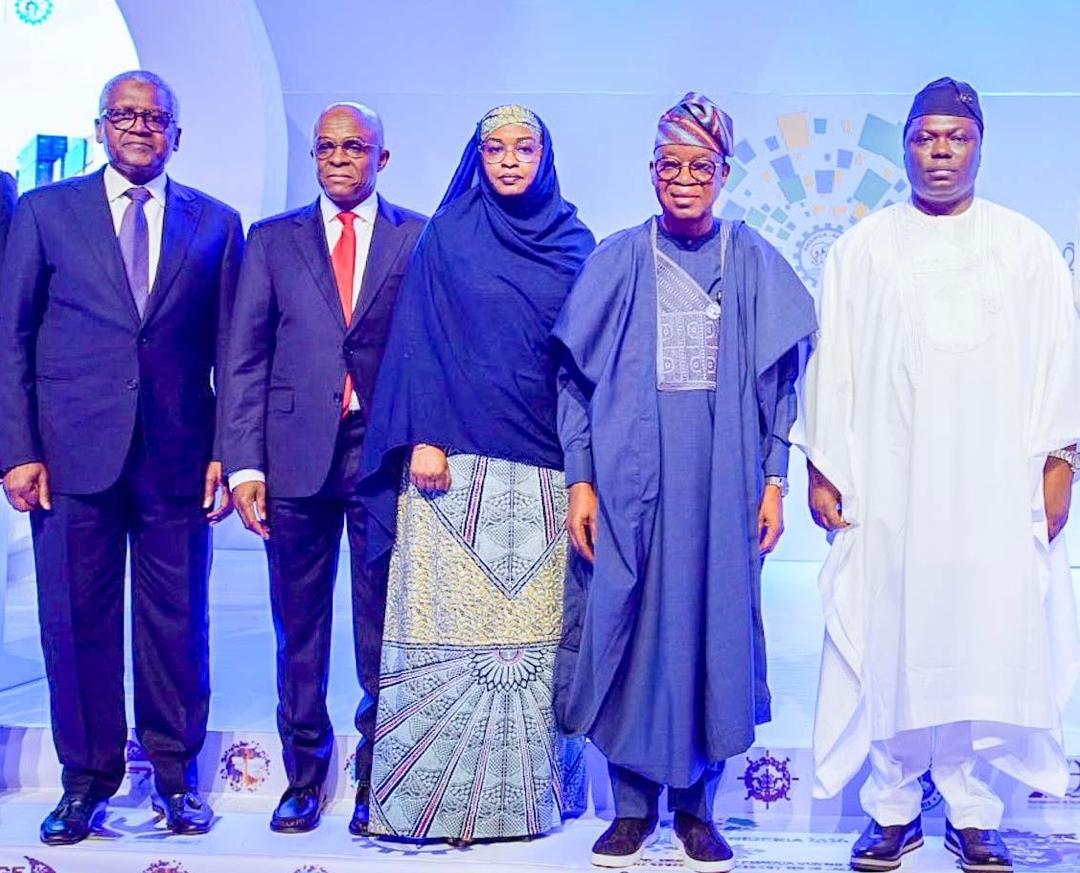
L-R: Chairman of Dangote Group, Alhaji Aliko Dangote; Managing Director, Nigerian Ports Authority and President of the Port Management Association of West and Central Africa (PMAWCA), Dr. Abubakar Dantsoho; Permanent Secretary, Federal Ministry of Marine and Blue Economy, Mrs. Fatima Mahmood; Minister of Marine and Blue Economy, Dr. Adegboyega Oyetola, and the Governor of Taraba State, Dr. Agbu Kefas, during the opening ceremony of the Mid-Year Session of the Board of Directors of PMAWCA hosted by NPA in Victoria Island, Lagos, on Monday.
The Minister of Marine and Blue Economy, Adegboyega Oyetola, has declared that Nigeria is expanding its port infrastructure and implementing sweeping maritime reforms aimed at positioning the country as the leading trade and logistics hub in West and Central Africa.
This was disclosed in a press release issued by the Special Adviser to the Honourable Minister
Federal Ministry of Marine and Blue Economy, Dr. Bolaji Akinola, on 18th May, 2026.
Speaking on Monday at the opening of the Mid-Year Session of the Board of Directors of the Port Management Association of West and Central Africa in Victoria Island, Lagos, Oyetola said the Federal Government had approved the development of additional deep seaports to boost cargo handling capacity, strengthen supply chain resilience and improve Nigeria’s competitiveness in global shipping.
The three-day meeting, themed Ports of the Future: Combining Logistical Resilience with Inclusive Community Development, brought together maritime stakeholders, government officials and investors from across the sub-region.
According to the minister, the administration of President Bola Ahmed Tinubu is prioritising port modernisation through infrastructure upgrades, digital transformation and improved operational efficiency.
Oyetola said approvals had been granted for the development of additional deep seaports across the country to complement existing infrastructure, strengthen supply chain resilience and reinforce Nigeria’s position as the preferred maritime and logistics hub for West and Central Africa.
He added that coordinated policy interventions and stronger collaboration among government agencies had significantly reduced logistics bottlenecks at Nigeria’s major seaports, leading to faster cargo evacuation, reduced vessel waiting time and improved operational efficiency.
The minister also highlighted the Federal Government’s National Single Window initiative, describing it as a landmark digital reform designed to streamline cargo clearance processes by integrating port operations and government agencies into a unified platform.
Oyetola further disclosed that existing ports would undergo major upgrades, including channel deepening projects aimed at attracting larger vessels and increasing trade volumes.
On maritime security, the minister said the implementation of the Deep Blue Project had helped eliminate piracy in Nigerian waters and drastically reduced maritime crimes across the Gulf of Guinea, restoring investor confidence in the region’s maritime corridor.
He urged delegates at the PMAWCA meeting to promote policies that would strengthen logistics resilience, encourage innovation and digital transformation, and ensure inclusive coastal community development.
In his welcome address, Managing Director of the Nigerian Ports Authority and President of PMAWCA, Abubakar Dantsoho, said West and Central Africa was witnessing a major resurgence in maritime infrastructure investment, with over $27 billion worth of port projects currently underway or recently announced across the region.
Dantsoho cited key projects including the $20 billion Simandou-Morebaya Deep Sea Port project in Guinea, the $2 billion Port San Pedro project in Côte d’Ivoire, the $1.5 billion Lekki Deep Sea Port, and ongoing port developments in Ghana and Senegal.
He also referenced ongoing investments in Nigeria’s Apapa and Tin Can Island ports, alongside a $600 million investment by APM Terminals.
According to Dantsoho, ports in West and Central Africa must evolve beyond their traditional role as cargo gateways and become catalysts for wider blue economy growth.
He said the future of the sector lies in areas such as renewable marine energy, aquaculture, sustainable fisheries, coastal tourism and marine biotechnology.
The event, which runs from May 18 to 20, was attended by the Governor of Taraba State, Kefas Agbu; Lagos State Commissioner for Transportation, Oluwaseun Osiyemi; President of the Dangote Group, Aliko Dangote; and Special Adviser to the President on Policy Coordination, Hadiza Bala Usman, among other dignitaries.





One Comment