

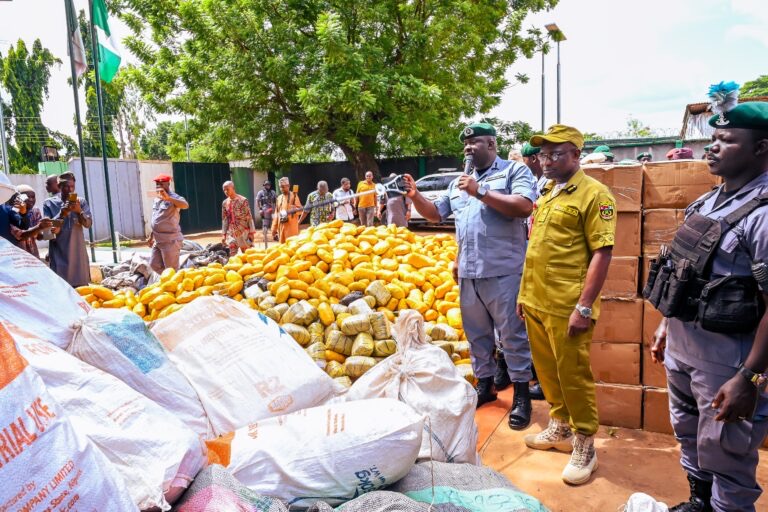
Along the Idiroko border corridor in Ogun State, a sprawling illicit economy is coming under increasing pressure as the Nigeria Customs Service intensifies its crackdown on smuggling networks. In just 41 days, operatives of the Ogun I Area Command intercepted contraband worth N6.77 billion, ranging from cannabis and foreign rice to petroleum products, expired foods and counterfeit pharmaceuticals, revealing the scale and sophistication of cross-border criminal trade threatening Nigeria’s economy, public health and security

In the last 41 days alone, operatives of the Ogun I Area Command of the Nigeria Customs Service (NCS) intercepted contraband goods valued at N6.77 billion. The seizures, ranging from narcotics and foreign rice to petroleum products, counterfeit medicines and expired food items, paint a vivid picture of an entrenched illegal economy thriving along Nigeria’s western border with the Republic of Benin.
At the centre of this unfolding crackdown is Deputy Comptroller Oladapo Afeni, the Acting Customs Area Controller, whose recent operational tempo has placed the Command among the most aggressive anti-smuggling formations in the country.
For Afeni, the figures are not just enforcement statistics, they represent a calculated attempt to dismantle a complex smuggling ecosystem that has long flourished under the cover of geography, demand gaps, and weak cross-border control mechanisms.
The Idiroko corridor is not merely a road; it is a sprawling economic and social ecosystem where legitimate trade and illicit commerce often blur into one another.
Hundreds of unofficial crossing points, locally referred to as “bush paths”, connect Nigeria to Benin Republic, making enforcement both physically and strategically difficult.
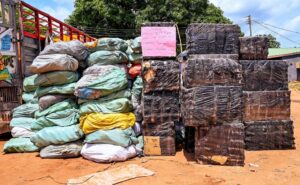

It is along these routes that smuggling syndicates move narcotics, food items, petroleum products and counterfeit goods into Nigeria’s densely populated southwest markets.
Afeni’s emergence as Acting Controller of Ogun I Command has coincided with a noticeable tightening of enforcement pressure along these corridors. Customs operations, once criticised for being reactive, have increasingly become intelligence-led, coordinated and sustained.
According to him, the Command recorded 73 seizures within just over a month, a figure that reflects both operational intensity and the scale of smuggling activity in the region.
The most significant of these was the interception of 10,126 parcels of cannabis indica, popularly known as “Ghana Loud”, weighing 4,627 kilograms and valued at over N5 billion on the illicit market.

Cannabis remains the most dominant illicit commodity moving through the Idiroko axis, feeding a growing domestic drug consumption market and an increasingly violent criminal ecosystem.
Afeni disclosed that from January to date, the Command has seized more than 26,000 parcels of cannabis sativa and indica combined. For enforcement officials, this is not merely a policing success, it is evidence of a deeply embedded supply chain stretching across West Africa.
“This isn’t just a seizure; it’s a preventive measure,” Afeni said during a briefing in Idiroko. “Without this intervention, our society would face a wave of drug-related crises that our already overstretched healthcare and rehabilitation systems cannot manage.”
Security analysts say the scale of drug movement through the border reflects the operational sophistication of transnational criminal groups who exploit Nigeria’s porous borders and high domestic demand.
Increasingly, narcotics trafficking is no longer viewed in isolation. Security agencies link it to broader patterns of insecurity, including armed robbery, cult violence, kidnapping and, in some cases, terror financing.
Beyond drugs, foreign rice remains one of the most frequently intercepted commodities in Ogun’s smuggling corridors.
In the latest operations, Customs seized 1,759 bags of foreign parboiled rice despite a longstanding federal policy restricting rice importation through land borders.
Nigeria’s rice policy has been at the heart of its broader import substitution strategy for nearly a decade. While the government argues that restrictions are necessary to protect local farmers and conserve foreign exchange, smuggling networks have consistently exploited price differentials between imported and locally produced rice.
Afeni maintains that such activities undermine national economic goals.
“Rice is a staple food eaten in many homes in the country,” he said. “Its importation through the land borders was prohibited by the Federal Government to encourage local production and self-sufficiency.”
However, market realities tell a more complex story. Local production has increased significantly in recent years, yet supply gaps, infrastructure limitations and consumer preferences for certain imported brands continue to sustain demand for smuggled rice. The result is a parallel market economy that customs officials are struggling to contain.
Perhaps one of the most revealing aspects of the recent seizures is the scale of petroleum product smuggling.
Customs operatives intercepted 14,550 litres of Premium Motor Spirit (PMS), underscoring how fuel subsidy removal and price differentials across borders have intensified cross-border fuel trafficking.
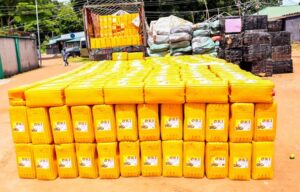
In addition, the Command has recorded repeated seizures of vegetable oil, including a major interception of a DAF truck carrying 2,185 kegs along the Shagamu Interchange-Ogere axis. Since assuming office, Afeni disclosed that 12,271 kegs of vegetable oil have been seized.
The implications extend beyond revenue loss. Nigeria’s edible oil sector, already strained by foreign exchange volatility and rising production costs, faces growing pressure from cheaper smuggled alternatives that bypass regulatory checks.
“The influx of foreign vegetable oil into the country is creating a ripple effect of negative consequences that demands immediate attention,” Afeni warned.
Industry stakeholders argue that unchecked smuggling weakens domestic manufacturing, discourages investment and leads to job losses across agricultural value chains.
One of the most alarming discoveries in recent seizures was the interception of 77 cartons of Analgin injections without NAFDAC registration numbers, alongside expired seasoning cubes and other unregulated food products.
Public health experts warn that Nigeria’s porous borders continue to expose consumers to counterfeit medicines and unsafe food items.
These products often enter informal markets where regulatory oversight is minimal, increasing risks for low-income populations who rely on cheaper alternatives.
Afeni’s Command has positioned these seizures as part of a broader public health protection effort, not just customs enforcement.
In a development that highlights the evolving nature of border crime, Customs also intercepted six live pangolins during recent operations.
Pangolins are among the most trafficked mammals globally, largely due to demand for their scales in illegal wildlife markets.
Their interception underscores the growing intersection between smuggling networks and environmental crime, positioning Nigeria as both a source and transit point in global wildlife trafficking routes.
Since taking charge of the Ogun I Area Command, Afeni has increasingly emphasised intelligence-led enforcement over conventional patrol operations.
The Command has begun deploying geospatial surveillance tools and digital tracking systems in line with the Nigeria Customs Service modernisation agenda under Comptroller-General Bashir Adewale Adeniyi.
This shift is aimed at improving real-time monitoring of border activity, strengthening coordination among units, and closing operational gaps exploited by smugglers.
Security experts say this approach reflects a broader transformation within Customs—from manpower-heavy patrols to data-driven enforcement systems capable of adapting to increasingly sophisticated smuggling tactics.
Collaboration and Revenue Balance
Despite the intense enforcement activities, the Command also recorded N125.43 million in revenue from baggage assessment and auctioned petroleum products within the review period.
It also facilitated the export of 95 metric tonnes of goods valued at over ₦1 billion Free on Board (FOB), highlighting the dual mandate of Customs as both enforcer and trade facilitator.
Afeni commended sister agencies,including the NDLEA, DSS, Nigeria Immigration Service and the Police, for their collaborative support in sustaining operations across the border corridor.
Despite the recent operational gains, experts caution that smuggling along the Idiroko axis is deeply entrenched and structurally sustained by poverty, regional price disparities, weak infrastructure and high consumer demand.
While Ogun Customs’ intensified enforcement under Afeni signals a more aggressive posture, the persistence of seizures suggests that smugglers remain highly adaptive.
For now, the battle continues along Nigeria’s western frontier, a contest not just between Customs officers and smugglers, but between formal regulation and a resilient shadow economy that has evolved over decades.
As enforcement tightens, one reality remains clear: the Idiroko border is no longer just a crossing point, it is a frontline in Nigeria’s broader struggle for economic stability, public safety and territorial control.








foiekh
h6b3a0