
The International Maritime Institute of Nigeria (IMION) has urged the Federal Government to translate Nigeria’s maritime policy commitments into measurable operational results, stressing that regulatory frameworks alone cannot deliver maritime security, efficient ports and economic growth without effective implementation.
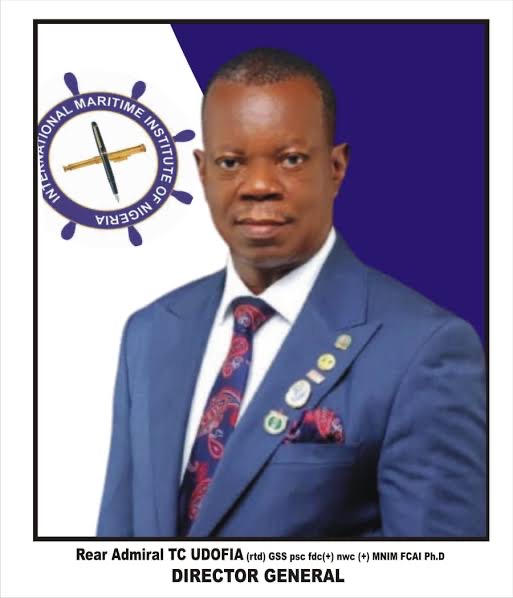
In a press release signed by its Head of Communications and Marketing, Dr. Bashir Ambi, the Director-General of IMION, Rear Admiral Thaddeus Christopher Udofia (rtd), said Nigeria must move beyond signing international maritime agreements to building the technical expertise, institutional capacity and operational discipline required to implement them across the country’s ports, waterways and maritime domain.
Udofia made the call to commemorate the 2026 World Maritime Day, themed “From Policy to Practice: Powering Maritime Excellence,” identifying human capacity development, maritime security, digitalisation and regulatory compliance as critical to translating policy decisions into tangible improvements in the maritime industry.
The institute also congratulated the Federal Government on Nigeria’s return to Category C of the International Maritime Organization (IMO) Council after a 14-year absence and the United States Coast Guard’s decision to lift its port security restriction on vessels arriving from Nigeria. IMION attributed the developments to sustained efforts to strengthen maritime security, including the Deep Blue Project, which it said had recorded more than three consecutive years without piracy incidents.
According to the institute, these achievements could reduce operational challenges for shipping companies, strengthen international confidence in Nigerian ports and improve the country’s position in global shipping and trade. However, it stressed that sustaining the gains would require stronger professional capacity and closer collaboration among government agencies, maritime institutions and private sector operators.
Established by the Nigerian Navy as a research based centre of excellence and strategic think-tank, IMION disclosed that it had trained more than 500 maritime stakeholders and senior executives since its inception. Its programmes cover blue economy governance, logistics and trade facilitation, maritime security and global trade, with the aim of bridging the gap between policy formulation and practical implementation.
The institute also highlighted its stakeholder backed five-year port transformation plan, designed to improve trade corridors, reduce transaction costs and address supply chain bottlenecks. In the fisheries sector, it is promoting a five-pillar strategy involving scientific fish stock assessments, coastal lagoon cage culture and satellite based spatial planning to support industry development and national food security.
IMION further disclosed that it had partnered with the Admiralty University of Nigeria to develop executive programmes that connect maritime research and intelligence with practical industry needs. It also conducts specialised training in maritime security and global trade to strengthen the capacity of professionals to address emerging threats and protect critical trade infrastructure in the Gulf of Guinea.
To improve public understanding of the blue economy, the institute said it had introduced a subsidised training programme for media practitioners to strengthen the accuracy and quality of maritime reporting. It added that its professional courses had been aligned with recent revisions to the Standards of Training, Certification and Watchkeeping for Seafarers Convention to prepare Nigerian maritime professionals for automation, green shipping technologies and decarbonisation.
IMION reaffirmed its commitment to evidence based policymaking, research and technical capacity development, urging sustained collaboration among government institutions, industry operators and other stakeholders to ensure that maritime policies produce measurable results and strengthen Nigeria’s competitiveness in the Gulf of Guinea.






One Comment