

The Registrar of the Council for the Regulation of Freight Forwarding in Nigeria (CRFFN), Kingsley Igwe, has said Nigeria could reduce total port and logistics costs by 14 percent and improve operational efficiency by up to 40 percent if the country fully adopts smart port systems.
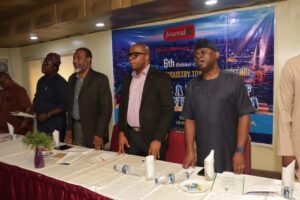
Igwe stated this while delivering his keynote address at the 6th Edition of the JournalNG Port Industry Town Hall Meeting held in Lagos on 24th April, 2026 . He stressed that global statistics has
shown that smart ports significantly cut operational costs while improving productivity.
He explained that although global benchmarks indicate a 14 percent reduction in port operational costs in ideal environments, Nigeria could achieve similar savings if it transitions to smart port operations.
“ There is a global statistics that has proven that smart ports can reduce the cost of port operations by 14 percent in an ideal environment. Judging from my experience both as a practitioner and regulator, if Nigeria advances into a smart port system, we will be reducing total ports and logistics costs by 14 percent, while efficiency will improve by 40 percent, especially in reducing labour costs,” he said.
According to him, personnel expenses account for between 60 and 70 percent of operational costs in most organisations, making technology-driven systems essential for reducing overheads and improving efficiency. Igwe described smart ports as technology-driven port environments that rely on automated systems, data analytics, artificial intelligence, and integrated infrastructure to enhance productivity and reduce reliance on manual processes.

He noted that Nigeria’s port operations remain largely dependent on outdated infrastructure and manual procedures, contributing to high logistics costs, inefficiencies, and delays across the supply chain.
The CRFFN Registrar emphasised that modern smart ports require advanced infrastructure, smart operating systems, and asset management platforms capable of detecting operational risks and abnormalities in real time.
He identified key technologies driving smart port development to include artificial intelligence, Internet of Things (IoT), blockchain systems, big data analytics, and reliable high-speed internet connectivity.
Igwe also stressed the need for round-the-clock port operations, noting that delays caused by limited working hours increase logistics costs and storage charges for cargo owners.
Igwe said adopting smart port systems in Nigeria would improve cargo predictability, reduce vessel waiting time, enhance cargo tracking, and strengthen Nigeria’s competitiveness in global trade.He added that smart port adoption would also help Nigeria improve its position in the global Logistics Performance Index and reduce congestion and cargo dwell time at its ports.
According to him, the economic benefits of smart ports include improved throughput, reduced annual financial losses caused by delays, and increased national revenue through more efficient logistics operations.
The Public Relations Officer of the Tin Can Island Port Command of the Nigeria Customs Service (NCS), Oscar Ivara said the Service is close to achieving full automation as part of efforts to support smart port operations and improve cargo clearance processes.
Ivara, who represented the Controller of the Command, Frank Onyeka, noted that the NCS has adopted several global trade facilitation policies, including Advance Ruling, Time Release Studies, and the National Single Window, with the Service already about 90 percent automated.
He explained that the introduction of modern systems such as the internet-based B’Odogwu platform has enhanced cargo clearance efficiency, allowing officers to process transactions remotely and improving operational speed.
According to him, the Customs Service is implementing the SMART Customs framework, focused on security, measurement, automation, risk management, and technology across its commands. He highlighted initiatives such as the Authorized Economic Operator (AEO) programme, risk-based cargo selectivity, satellite imagery at border posts, and continuous capacity building for officers.
Ivara added that these technological advancements are aimed at optimizing cargo clearance, strengthening national security, and positioning the Nigeria Customs Service to support efficient, technology-driven port operations.









uf6sfv