


By Robert Egbe

Nigeria’s effort to recalibrate its tax policy in favour of public health has reached a defining moment with the ongoing debate over Sugar-Sweetened Beverages (SSBs).
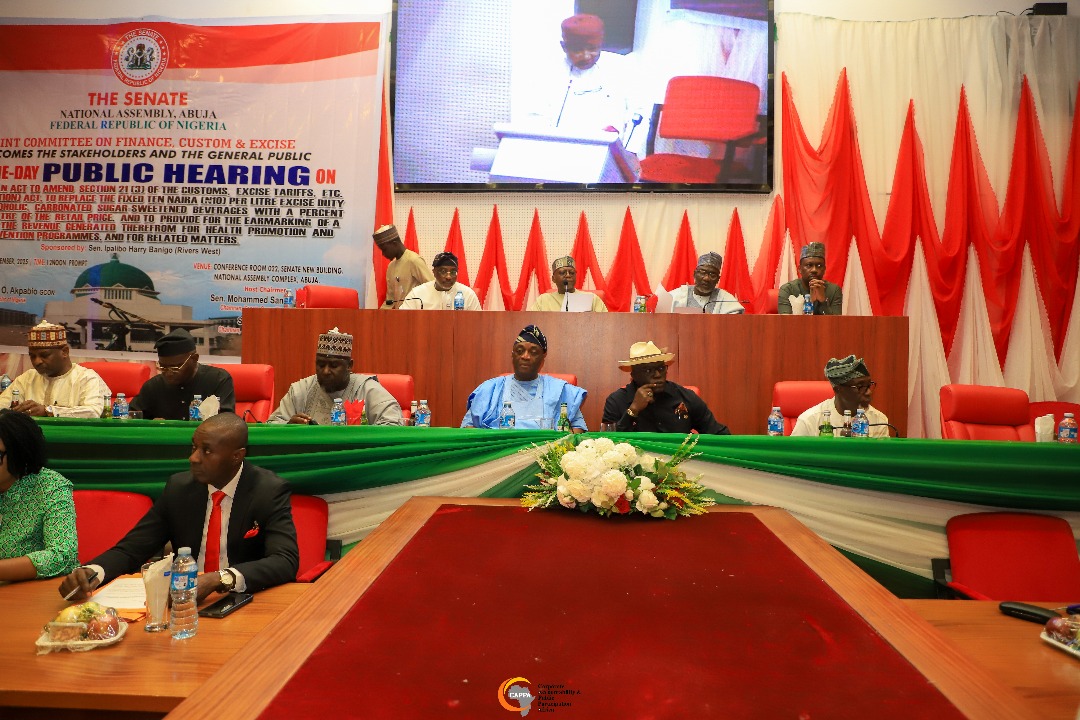
Last November, the Senate Joint Committee on Finance, Customs and Excise held a public hearing in Abuja to consider a bill seeking to amend the excise duty regime for non-alcoholic, sweetened, and carbonated drinks.
The proposed legislation—A Bill for an Act to Amend Section 21(3) of the Customs, Excise Tariffs, Etc. (Consolidation) Act—aims to replace the current flat ₦10-per-litre excise duty with a percentage-based levy tied to retail price, while earmarking part of the revenue for health promotion and disease prevention.
Sponsored by Senator Ipalibo Harry Banigo, the bill reflects mounting scientific and public-health evidence linking SSB consumption—including soft drinks, energy drinks, and sweetened juices—to Nigeria’s growing burden of non-communicable diseases (NCDs).
At the hearing, Senate President Godswill Akpabio, represented by Senator Adeniyi Adegbonmire, underscored the broader significance of the proposal.
He described it as “not merely fiscal in nature, but a public health investment strategy that aligns taxation policy with our national health priorities,” noting that the goal is to redirect existing revenue toward health programmes rather than impose additional hardship on citizens.
That framing is both accurate and urgent.
Globally, sugar-sweetened beverages are recognised as major contributors to obesity, type 2 diabetes, cardiovascular diseases, childhood malnutrition, and premature death.
In Nigeria, consumption—particularly among children and young adults—has risen sharply. Today, NCDs account for nearly 30 percent of annual deaths, exerting immense pressure on households and an already fragile healthcare system.
Nigeria has also become one of the fastest-growing markets for sugary drinks worldwide. Estimates suggest the average consumer drinks about six bottles weekly, spending roughly ₦2,500. The consequence is a steady rise in diet-related illnesses that were once considered rare in the country.
The human and economic costs are staggering. According to the Diabetes Association of Nigeria, about 30,000 Nigerians die annually from diabetes, while an estimated 11.4 million live with the condition. Managing diabetes costs between ₦100,000 and ₦120,000 monthly—well beyond the reach of most families.

The outlook for heart disease is even bleaker. As of 2021, Nigeria had only 13 heart surgery centres and roughly 80 heart surgeons serving a population of over 200 million. With surgery costs now exceeding ₦5.5 million, life-saving care remains inaccessible for most Nigerians.
In recognition of this crisis, the government introduced an excise duty on SSBs through the 2021 Finance Act, imposing a ₦10-per-litre levy. While this was a step in the right direction, the tax has proven far too weak to influence consumption or health outcomes.
Today, a 33cl bottle of soft drink sells for between ₦350 and ₦500, yet the excise duty remains unchanged. The result is a levy that barely affects retail prices, fails to discourage consumption, does not incentivise reformulation, and is easily absorbed by manufacturers.
This weakness is especially troubling given Nigeria’s chronic underinvestment in health. Less than five percent of the national budget is allocated to the sector—far below the 15 percent target set by the Abuja Declaration.
Patients shoulder crushing out-of-pocket costs, health workers continue to emigrate, and donor funding is declining.
As the Coordinating Minister for Health and Social Welfare, Professor Muhammad Ali Pate, has acknowledged, the system is stretched to breaking point.
Yet, recent fiscal reforms once again sidelined health, earmarking funds for education, technology, defence, and cybersecurity—while leaving public health out of the equation.
Against this backdrop, the proposed amendment before the National Assembly is both timely and necessary.
A retail-price-based SSB tax would more effectively reduce consumption, encourage manufacturers to lower sugar content, and generate sustainable funding for health promotion.
Unsurprisingly, industry opposition has been swift. Manufacturers warn of job losses, factory closures, and economic hardship—arguments long used against tobacco, alcohol, and other public-health regulations. International experience, however, consistently disproves these claims.
More than 50 countries, including South Africa, Mexico, the United Kingdom, Saudi Arabia, and the Philippines, have implemented similar taxes without widespread job losses. Instead, companies adapt by reformulating products and investing in healthier alternatives.
The alarmism is particularly unconvincing given that many of these companies continue to report strong revenues and profitability in Nigeria and across Africa. Economic fragility appears to surface only when modest accountability for public-health harm is proposed.
The true economic question is not corporate profit, but the cost of inaction. Nigerians spend an estimated ₦1.92 trillion annually treating NCDs through healthcare expenses, lost productivity, and premature death.
Prevention—through an effective SSB tax—is far cheaper and far more sustainable.
It is also important to clarify that this proposal is not a “sugar tax.” It targets sugar-sweetened beverages, not sugar itself, and does not affect farmers, traditional foods, or local diets.
Ultimately, this debate is about political will. Governments exist to protect public welfare, not to prioritise corporate margins over human lives. Strengthening Nigeria’s SSB tax aligns with global best practice and responds directly to the country’s escalating health crisis.
Accordingly, Nigeria should:
Adopt a strong retail-price-based excise duty, set at 50 percent of retail price with a minimum floor of 20 percent, in line with WHO guidance and the Bloomberg Task Force on Fiscal Policy for Health.
Earmark SSB tax revenues specifically for NCD prevention and management to ensure sustainable health financing.
Establish a national monitoring and evaluation task force to oversee implementation, ensure compliance, and assess health and fiscal outcomes.
Nigeria cannot afford further delay.
As NCD rates climb and healthcare costs soar, maintaining an ineffective ₦10-per-litre tax amounts to policy complacency.
The real question is no longer whether the SSB tax should be strengthened, but whether public health will finally be placed above private profit.
The answer should be unequivocal.
Egbe is a healthy food advocate at Corporate Accountability and Public Participation Africa (CAPPA).







7mw93z
khziq5
r0dfyp