
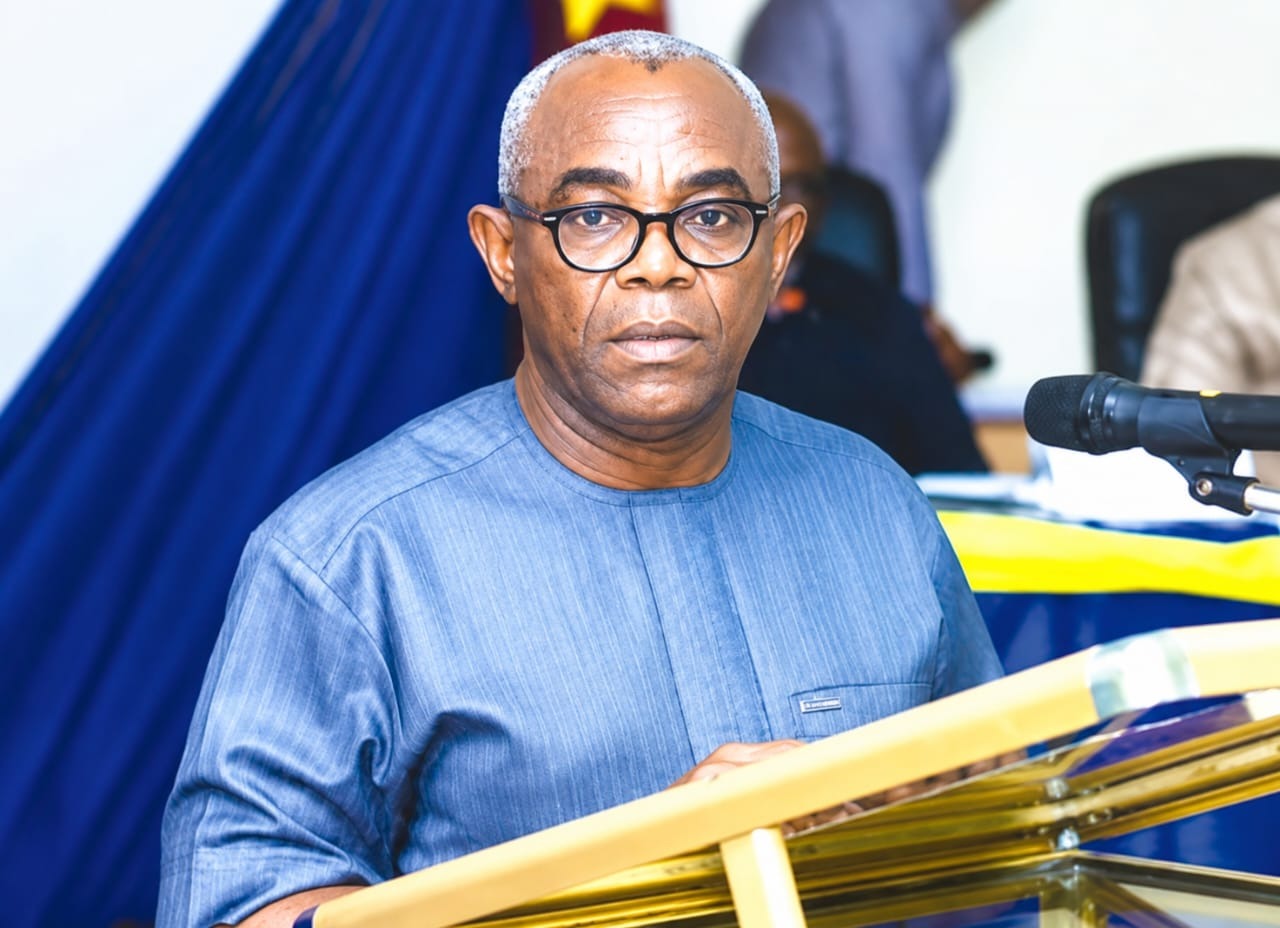
As Africa looks to unlock the enormous opportunities in its maritime and blue economy, Dr. Jethro W. Brooks Jr., Acting Vice-Chancellor of the Regional Maritime University (RMU) Ghana, says the continent must look beyond traditional seafaring and invest in education, data, skills development and stronger cooperation among maritime institutions.
In this interview with the JournalNG’s team of Ismail Aniemu, Feyisola Adeyeha and Hannah Tedunjaye at the recently held Blue Africa Conference and Exhibition (BACE) in Lagos, Brooks discusses RMU’s new master’s programmes, the untapped opportunities in Africa’s maritime sector, the need for better data sharing, local content, and the importance of preparing young Africans for maritime related careers.
Why Africa Must Undergo Training to Harness Blue Economy Potentials- Brooks
As Africa looks to unlock the enormous opportunities in its maritime and blue economy, Dr. Jethro W. Brooks Jr., Acting Vice-Chancellor of the Regional Maritime University (RMU), says the continent must look beyond traditional seafaring and invest in education, data, skills development and stronger cooperation among ma
Question: For the record, sir, could you please introduce yourself and tell us about your role at the Regional Maritime University?
Answer: My name is Dr. Jethro W. Brooks Jr. I am the Acting Vice-Chancellor of the Regional Maritime University.
Question: How will the three new master’s programmes introduced by the university contribute to the growth of the African maritime sector and the development of the blue economy?
Answer: Those programmes take us to another level. Most people have been doing certificate programmes in the blue economy, while some institutions have developed bachelor’s programmes, but now we are taking it to the master’s level.
The programmes cover areas including international logistics and blue economy activities, and they are designed as hybrid programmes. They should start by the end of this month, and students will have the option of studying in person or online.
Question: Africa has enormous maritime resources, but much of the continent’s blue economy potential remains untapped. What needs to change?
Answer: The first thing is education and sensitisation, followed by encouraging students and young people to take advantage of the opportunities available in the blue economy and maritime-related fields.
When people hear the word maritime, they often think only about sailors or going to sea, but maritime activities go far beyond seafaring.
There are opportunities both offshore and onshore, particularly in communities and economies that have access to water bodies.
You can remain onshore and still participate in a wide range of maritime activities, so we need to educate people about the full scope of the sector and make them understand that they do not necessarily have to go to sea to build a maritime career.
Question: What opportunities do you see for stronger collaboration among African maritime universities?
Answer: Gradually, we are trying to move in that direction. In the past, we saw individuals and institutions working independently on maritime activities, but increasingly, more organisations are recognising the need to bring their efforts together because together we are stronger and can achieve more.
Maritime development is costly because it involves both water- and land-based infrastructure, but if we put our resources together and educate our people properly, we can take greater advantage of the water bodies across the continent.
Collaboration will allow institutions to share expertise, facilities, training programmes and resources rather than each country trying to do everything alone.
Question: The maritime sector has recently been recognised as an important part of Africa’s economic transformation. From your perspective, what opportunities does the blue economy present to Africa?
Answer: It is another avenue for job creation and another area of economic activity that has been elevated in recent times. Traditionally, we have focused heavily on land-based resources such as gold and diamonds, but we are increasingly recognising that there are also enormous resources offshore and within our rivers, lakes and oceans.
The important thing is that we must protect those ecosystems while taking advantage of the resources they provide. Whether it is the sea, ocean, lake or river, these water bodies are our friends and we should treat them as such because when we protect them, we are talking about sustainability, and that is at the heart of the blue economy.
We should not simply extract resources and make money today while forgetting about tomorrow. We need to blend the concept of the ocean economy with the blue economy so that economic activities are carried out in a sustainable way. The opportunities are vast, but we must use them responsibly.
Question: You spoke about data collection and the challenges of data availability. What can be done to ensure that enough maritime data is collected and made accessible?
Answer: We need to look at the entire data process, including collection, storage, dissemination and access, because these are different aspects of data management. As I said earlier, data does not lie. It tells you what is there.
Sometimes, however, people try to manipulate information for personal, collective or selfish reasons, and that can create the impression that the data is not telling the truth. In reality, data tells the truth, while statisticians provide estimates and account for margins of error.
The bigger challenge is often the willingness to share information. Some organisations and individuals fear that when they provide data, it may be used against them or expose things they would rather keep hidden. This becomes a particular problem for students and researchers pursuing master’s and PhD programmes because they may know that information exists but struggle to access it.
Some countries have freedom-of-information laws that allow people to legally request information that should be available, and that is one approach that can help improve access to public data.
Question: From a trainer’s perspective, how can maritime administrations across Africa help generate data for development and make it easily accessible?
Answer: Data collection is not as difficult as people think if there are quality procedures and clear guidelines for how information should be collected, stored and disseminated. The challenge, again, is trust, because people sometimes fear that the information they provide could be used against them, while others simply do not share the information.
Take port state control, for example ,if an officer inspects a vessel in Togo, the information from that inspection should be uploaded to a central system. When the same vessel arrives in Ghana, the authorities should be able to access the information rather than repeating the same inspection unnecessarily. The same should apply when the vessel reaches Nigeria.
If the information is not uploaded on time, the shipowner may end up paying for the same inspection several times. A central platform where information is uploaded and shared promptly would make the process easier for data collectors, those storing the information and those who need to use it.
Technology also means that we do not necessarily need a huge workforce to manage the system. A small number of people can operate a central platform that serves dozens of countries, provided the system is properly designed and maintained.
Question: With Africa’s vast maritime coastline, do you think we have enough manpower to match the size of the sector, and if not, what is RMU doing to increase the numbers?
Answer: That is one of the reasons RMU is putting short-term and targeted programmes in place. You do not always have to enrol in a four-year or two-year programme. There are shorter courses designed to address specific needs in the maritime industry, including programmes related to maritime data collection and other specialised areas.
We have had programmes such as COGSWIM and other targeted initiatives that provide specific skills required by the maritime sector. The important thing is to identify the gaps and train people to fill them.
I also believe technology changes the way we think about manpower. European and American institutions share information electronically, so Africa can also develop central platforms where maritime professionals across different countries can upload and access information.
The issue is not always how many people we have available; it is how effectively we train them, use technology and share information.
Question: What can be done to get more Africans working on ships that trade within Africa?
Answer: Cabotage is an important part of the solution because it allows countries to regulate activities within their internal waters and create opportunities for local participation. If a vessel is operating under a country’s flag, the country can develop policies requiring local participation, such as having Nigerian sailors on vessels flying the Nigerian flag.
West Africa has enormous opportunities because of its waterways. Take the routes between Freetown and Lungi in Sierra Leone, for example, or the inland vessels operating between different states in Nigeria. We need to ask how many local people are actually working on those vessels.
There is an opportunity to train local pilots, captains, engineers and other professionals to operate these vessels, and that creates jobs. We should also look at other maritime-related jobs beyond the traditional positions.
I recently visited a harbour and dry dock and saw non-local workers operating forklifts and cranes even though local people were available. These are skills that can be acquired relatively quickly. At RMU, for instance, someone can train to become a forklift operator in about eight weeks, while crane operation can take around 12 to 16 weeks.
The opportunities are there; what we need is collaboration and a deliberate effort to train and employ Africans.
Question: Does RMU have the capacity to help other African countries train their maritime workforce?
Answer: Absolutely. If a country wants to train people in piloting, maritime operations or training-of-trainers programmes, it can come to RMU and we can work together. Institutions with the authority to issue STCW certificates can play an important role in supporting countries that are still developing their maritime training capacity.
Instead of sending 10 or 15 people abroad at enormous cost, a country can invite RMU to conduct an assessment of its facilities and determine what needs to be improved. We can look at the training facilities, workshops, swimming pools, firefighting facilities and other requirements, identify the gaps and help the country develop its own capacity.
If a country has already sent 10 or 15 people to RMU for training, we could potentially come to that country and train 50 people locally, provided the necessary facilities are available. That would cost less and create more value.
We recently had an example where people were sent abroad for training at a cost that was significantly higher than what the same training would have cost at RMU. One person’s training cost abroad could have covered the cost of training several people at RMU.
We also need to look inward and recognise the capacity we have within Africa. We should ask what our neighbours can help us do rather than automatically looking outside the continent.
Question: What advice would you give to young people aspiring to build careers in the maritime industry?
Answer: The first thing is to position yourself and prepare to enter the maritime field.
Young people should not think that maritime means they must go to sea. Some people are afraid of water or simply do not want to work onboard ships, but there are many opportunities onshore.
You can work in logistics, become a fleet manager, transport officer or pursue many other maritime-related careers without going offshore. There is an entire chain of maritime activities that takes place on land, so young people should educate themselves about the opportunities and choose an area that suits their interests and abilities.
Question: Finally, what more needs to be done to educate communities living around Africa’s water bodies?
Answer: It is important to educate and sensitise communities that live around water bodies because they have depended on these resources for generations and see them as part of their daily lives.
We need to show them that sustainable practices can actually improve their livelihoods. For example, instead of fishing in a way that removes young fish before they mature, they can be taught practices that allow fish stocks to grow.
Some countries have periods when fishing is prohibited so that young fish can mature, while others impose penalties when fishermen catch undersized fish.
Those rules and regulations need to be enforced, but enforcement must go together with education. Communities need to understand that protecting the resources today means they will still have those resources to depend on tomorrow.
Ultimately, Africa has the resources and the opportunities, but we need to educate our people, strengthen our institutions, share data, develop local skills and collaborate across borders. If we put our efforts together, the blue economy can become a major driver of jobs, sustainable development and economic growth across the continent.


One Comment