


The Council for the Regulation of Freight Forwarding in Nigeria (CRFFN) has intensified efforts to sanitise the freight forwarding industry, warning operators against imposing unauthorised charges on cargo and unveiling plans to bring tens of thousands of practitioners under its licensing regime within the next five years.
The council said the move is aimed at reducing logistics costs, eliminating illegal charges and ensuring that only qualified and duly registered practitioners operate in the industry.
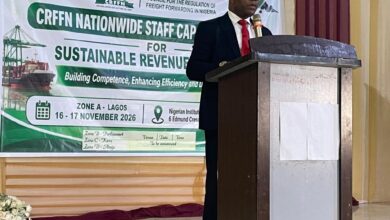
Speaking in Lagos during the maiden session of a nationwide capacity-building programme for CRFFN staff, the council’s Registrar and Chief Executive Officer, Dr Kingsley Igwe, said the regulation of freight forwarding must go beyond licensing practitioners to ensuring that the regulator has a competent workforce capable of effectively overseeing the sector.
He said freight forwarding is a highly specialised, knowledge-based profession that plays a critical role in moving cargo from exporting countries through Nigerian ports and airports to the final destination of importers.
According to him, the Federal Government established the CRFFN in 2007 under Act No. 16 of 2007 to professionalise the industry, determine standards for the practice of freight forwarding, issue licences to intending practitioners and regulate the profession in line with global best practices.
He said the council’s responsibility made continuous training of its workforce necessary, adding that the nationwide capacity-building programme is designed to equip staff with the professional knowledge required to effectively regulate the industry.

“This is primarily what has informed the training of CRFFN staff today. This training is happening nationwide. This is the maiden session, beginning in Lagos,” he said.
He explained that the programme would subsequently be extended to Port Harcourt for the South-South and South-East zones, Abuja for the North-Central zone and Kano for the northern zones.
The registrar said freight forwarding requires sound knowledge of international trade procedures, global conventions and cargo documentation, including bills of lading and other relevant shipping documents.
He noted that with a large proportion of Nigeria’s international cargo moving through the sea, and others through the air, the freight forwarding industry remains a critical link between international trade and the domestic economy.
“Without the freight forwarder, those cargoes cannot safely, professionally and efficiently move from exporting countries and land safely at the warehouse of the importing party,” he said.
He added that the complexity of the profession makes it unsuitable for untrained individuals, stressing that effective regulation is necessary to protect the integrity of the industry and improve service delivery.
On registration and licensing, the CRFFN boss disclosed that the council currently has close to 10,000 registered freight forwarders, comprising individuals and corporate entities.
He said the council has commenced a new licensing scheme, with more than 1,000 applications currently being processed.
Under the new scheme, he said the council is targeting between 20,000 and 25,000 licences for corporate entities within the next five years, while more than 40,000 individual practitioners are also expected to be licensed during the period.
He said the licensing exercise would enable the council to identify and remove operators who are not duly registered or licensed.
“We are licensing, and through licensing, we will be able to fish out every operator that is not duly licensed or registered,” he said.
The registrar also disclosed that the council expects to generate about N300 million annually from the licensing scheme.
He, however, stressed that the council’s regulatory drive is not solely about revenue generation but about professionalising the industry and ensuring that operators comply with established standards.
A major focus of the council’s regulatory drive, he said, is the elimination of illegal charges imposed on cargo entering or leaving Nigeria.
He disclosed that the council has recently issued a circular banning the imposition or collection of fees that are not statutory or approved by the relevant authorities.
According to him, unauthorised charges increase the cost of logistics and ultimately contribute to higher prices of goods in the Nigerian market.
“Any fee that is imposed on cargo entering or leaving Nigeria that is not statutory and approved is actually illegal, and it makes the cost of commodities in the market high,” he said.
He clarified that legitimate statutory charges, including import duties and approved service charges by relevant regulatory agencies, remain valid.
However, he said any charge outside the approved framework would not be tolerated.
“We reiterate that unofficial fees are hereby banned and suspended,” he said, warning that those found collecting illegal charges would face sanctions.
He said the warning applies to culprits operating at port terminals and those collecting unauthorised charges along the roads.
“Culprits found collecting illegal fees, whether at the port terminals or on the road, will be severely dealt with according to the law,” he said.
The registrar said the council’s regulatory and licensing measures are part of broader efforts to reduce the cost of logistics and make the movement of cargo through Nigeria more efficient.
He also linked the growth of the freight forwarding industry to Nigeria’s broader economic ambitions, arguing that a well-regulated and professionally driven sector could contribute significantly to the country’s economic growth.
He said the council would continue to strengthen the capacity of its workforce while expanding the licensing framework to ensure that practitioners and operators meet the standards required to operate in Nigeria’s freight forwarding industry.





One Comment