
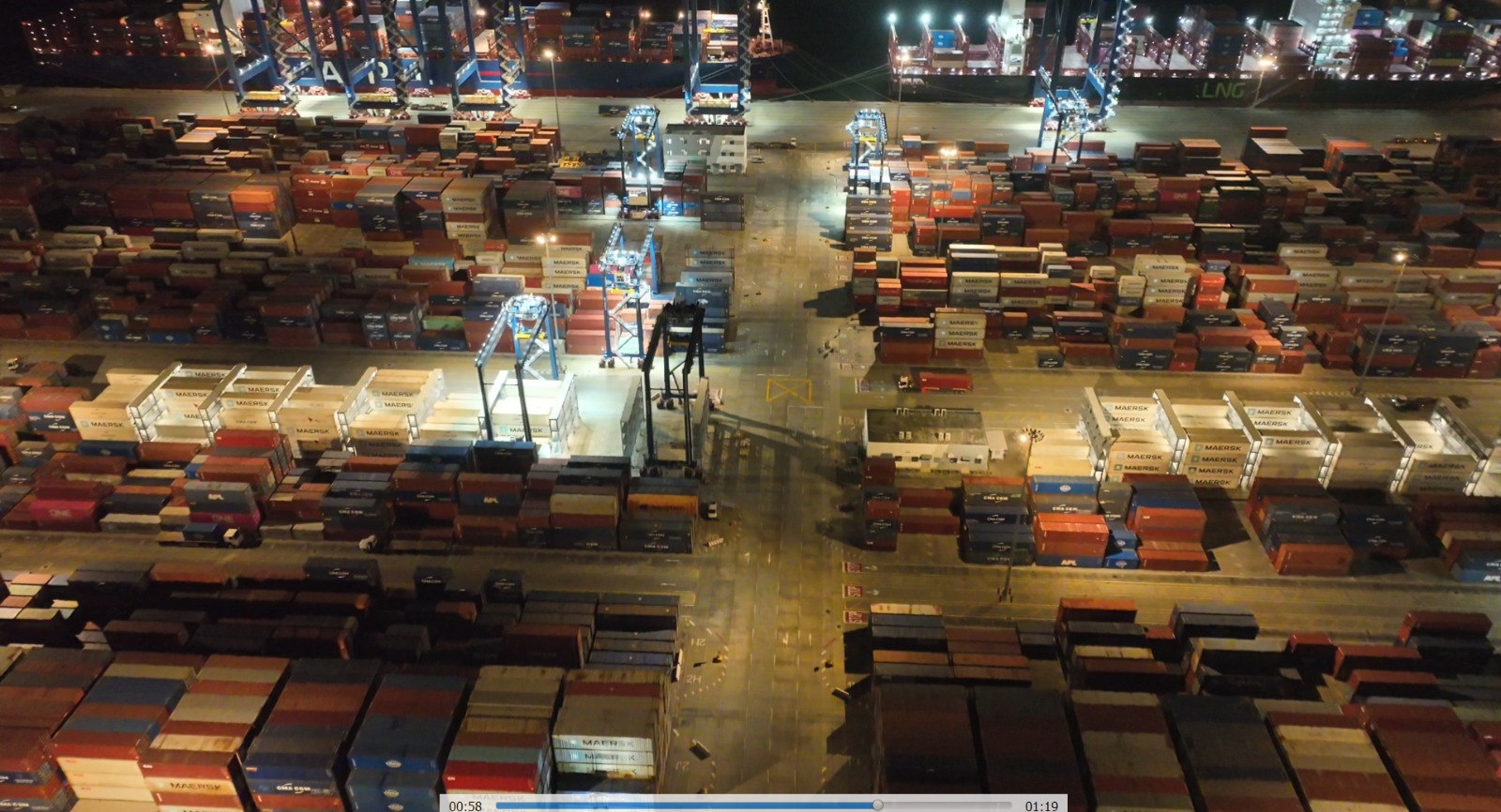
Lekki Deep Sea Port tells a different story at night. Away from the daytime traffic and beehive of activities that characterises a port environment, the real test of a modern port unfolds under floodlights, with cranes in motion, trucks lining up, and vessels being worked in steady rhythm.
Recently, Lekki Port hosted some journalists in a strategic visit to inspect clandestine activities at Nigeria’s first deep seaport and as one of those privileged to be on that tour, what I witnessed was a facility that is not only alive after dark, but increasingly positioning itself as a 24-hour engine of trade for the country.
The ambience was striking. Massive ship-to-shore cranes hovered over container vessels like silent giants, automated stacking cranes glided seamlessly across the terminal yard, and truck headlights traced glowing lines as cargo exited the port long after sunset. Unlike many Nigerian ports that wind down with daylight, Lekki operates a full day-and-night shift system, with port workers, terminal operators, security personnel and logistics providers actively engaged around the clock. Ships are worked at night, containers are discharged and loaded, and cargo evacuation continues deep into the early hours.
Operationally, the port is fast gaining market confidence. Management confirmed that Lekki is already operating at close to 50 percent of its designed capacity, with steady month-on-month growth in container throughput. This is a significant milestone for a port that only recently commenced full commercial operations. The presence of mega vessels, the pace of crane movements, and the volume of trucks leaving the terminal at night all point to a facility that is gradually embedding itself into regional and global shipping networks.
Yet beneath this impressive infrastructure and nocturnal efficiency lies a set of systemic bottlenecks that threaten to dilute Lekki’s full potential.
Ironically, the port’s biggest strength is also being undermined by legacy systems. Lekki is designed as a fully automated terminal, built for end-to-end digital operations, from vessel planning and cargo handling to gate processes and terminal management systems.
However, this advantage is significantly weakened by the continued dependence on physical cargo examinations by the Nigeria Customs Service and other regulatory agencies. Manual inspections slow down cargo flow, increase dwell time, and erode the speed gains that automation was meant to deliver.
The second major challenge is cargo evacuation. For a deep-sea port engineered to handle large vessels and massive cargo volumes, multimodal connectivity remains weak. Barge operations currently account for only about 10 percent of cargo evacuation, while rail connectivity is completely absent. The overwhelming reliance on road transport means that even at current throughput levels, evacuation pressure is already building.
As volumes grow, congestion risks will multiply, not because the port cannot handle more cargo, but because the surrounding logistics ecosystem cannot.
Infrastructure development outside the port gates is struggling to keep pace with what has been built inside.
But with the Lagos-Calabar Coastal Road and other access roads offering subtle relief as well as long-term hope, it remains to be seen if Lekki Port will not become the port of destination of choice in few years.

Though, rail still remains the missing strategic link, especially with the rapid expansion of industrial activities within the Lekki Free Trade Zone corridor, it is believed that volume of cargoes from the Port will outnumber the volume obtaining from existing ports all combined. Without rail access, the port’s ability to scale efficiently will be structurally constrained, regardless of how advanced its internal systems may be.
What makes this contrast more compelling is that Lekki itself is not the problem. At night, the port performs exactly as a modern deep-sea terminal should. Ships are working without interruption. Equipment uptime is high. Workforce scheduling supports continuous operations. Cargo is visibly exiting the port after dark, a rare but refreshing sight in Nigeria’s maritime landscape.
At Lekki Port, the infrastructure exists and modern state-of-the-art technology is in place. The human capital is already deployed in 24-hour shifts to support efficient nighttime operations. What remains is policy coherence and institutional modernization.
Fix these systemic gaps, and Lekki Deep Sea Port does not need physical expansion to double performance. Efficiency alone will do it. At night, under the glow of container cranes and moving cargo, the future of Nigeria’s port system is already visible. We witnessed seamless clandestine port operations at Lekki Port.






Get ready for some spooky fun! pac man halloween 2025 edition brings classic maze-chasing action with a festive twist. Enjoy the familiar gameplay you love, now with a charming Halloween theme that’s perfect for the season. It’s a delightful and engaging experience for fans of all ages!