
The push to establish an African Maritime Organisation is gaining momentum as the Maritime Organisation of West and Central Africa (MOWCA) intensifies efforts to unite the continent’s maritime administrations and strengthen Africa’s voice in global maritime affairs.
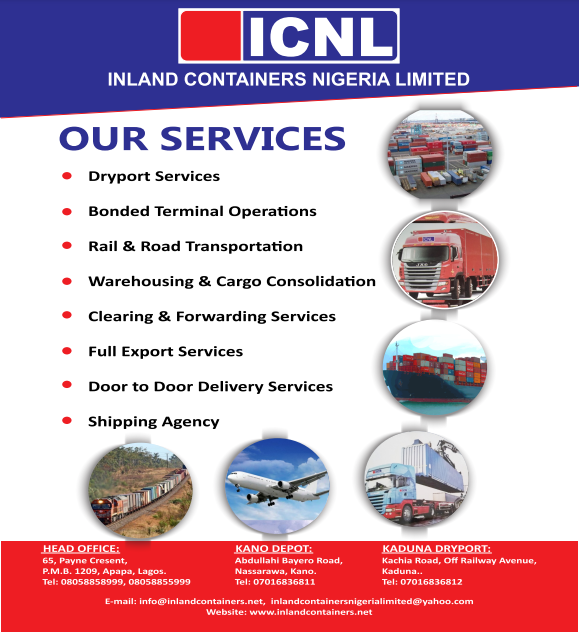
For MOWCA Secretary-General, Dr Paul Adalikwu, the creation of a continental maritime body is no longer an idea that should remain on the drawing board. It is a strategic necessity if Africa is to move from being largely a participant in the global maritime economy to becoming a force capable of influencing and shaping it.
Speaking during the maiden edition of the Blue Africa Conference and Exhibition in Lagos, Adalikwu disclosed that MOWCA has been working with the African Union, the International Maritime Organisation (IMO), the Association of African Maritime Administrations and member states to advance the initiative.
The revised African Transport Charter, adopted by the African Union last year, provides for the establishment of an African Maritime Organisation under Article 5, giving further impetus to the campaign.
Adalikwu said 25 countries under the MOWCA umbrella had already adopted the necessity for the establishment of the organisation, with about five additional countries needed to achieve the required quorum. He also disclosed that the President of Togo had developed a draft bill, in collaboration with MOWCA, which is undergoing review ahead of its proposed submission to the AU Heads of State Summit.
The proposed organisation is expected to provide Africa with a common platform for coordinating maritime interests and presenting a united position at international forums, particularly the IMO. For a continent with extensive coastlines, major shipping routes, significant ports and enormous blue economy resources, the absence of a strong continental maritime institution has remained a major gap in Africa’s quest for greater influence in global shipping.
MOWCA’s campaign goes beyond the establishment of a continental body. The organisation is simultaneously working to address some of the structural weaknesses that have continued to limit Africa’s participation in the maritime value chain.
At the centre of these efforts is human capacity development. One of the major initiatives undertaken under Adalikwu’s leadership was the securing of a $1.7 million grant from the government of Indonesia to train lecturers in maritime education and training institutions on the requirements of the IMO under the Standards of Training, Certification and Watchkeeping (STCW). The programme provided 97 training positions for beneficiaries from MOWCA member states, who undertook one month training in Jakarta.
Singapore has also agreed to provide similar capacity building opportunities for member states, although some programmes have been temporarily affected by geopolitical developments and disruptions around the Strait of Hormuz.
MOWCA is also seeking to deepen cooperation among maritime institutions within Africa. The Regional Maritime University in Accra, Ghana; the Academy of Science and Technology of the Seas in Abidjan; and the Maritime Academy of Nigeria are being brought together to promote the exchange of students and lecturers, joint research and the sharing of global best practices.
The emphasis on training is deliberate. Africa’s maritime transformation cannot be achieved without a pool of adequately trained professionals capable of operating ships, managing ports, developing maritime technology and providing the technical expertise required across the industry.
Yet, for young maritime graduates, completing academic and professional training is only part of the journey. Obtaining the sea time experience required for certification remains a major challenge. MOWCA is attempting to address this through its partnership with Blue Kauri Africa Shipping Line.
The company is expected to commence operations in November with three vessels acquired for door-to-door shipping services in West and Central Africa. Under an MOU signed with MOWCA, the organisation is engaging the company to create opportunities for young African men and women to secure placements on the vessels and obtain the sea-time experience required for certification.
If sustained, the initiative could help create a new generation of African seafarers with the practical experience required to compete for opportunities in the international shipping industry. Indigenous ship ownership is still relatively low across the continent, largely because of the enormous capital required to acquire and maintain vessels.
This is why MOWCA is pushing for the establishment of a Regional Maritime Development Bank capable of providing single-digit interest financing, grants and loans for maritime infrastructure and private sector development.
Adalikwu has also welcomed Nigeria’s progress towards launching the Cabotage Vessel Financing Fund, which he believes could help Nigerians acquire vessels individually or through partnerships and strengthen indigenous shipping capacity.
The organisation’s maritime development agenda also extends beyond ships and finance to infrastructure. Africa’s shortage of modern ship-repair facilities and dry docks means that vessels often have to travel outside the continent for maintenance, repairs and other technical services, resulting in the loss of revenue and business opportunities.
To address this, MOWCA recently secured a $500,000 grant to conduct a study on dry docks and ship-repair facilities across the region. The study is expected to identify opportunities for investment in facilities capable of servicing and maintaining vessels, as well as constructing speedboats and other vessels.
The Danish government has also reaffirmed its commitment to supporting the development of Nigeria’s maritime sector, with an advocate for stronger collaboration among government agencies, the private sector and other stakeholders. Head of Business Diplomacy at Royal Danish Embassy, Jettte Bjerrum, in her remarks at the event said Denmark’s own maritime success had been built on coordinated policies, private-sector investment and strong institutional collaboration, noting that the same approach could help Nigeria develop its ports, marine resources, skills and supporting infrastructure.
She added that the maritime and agricultural sectors were closely linked, particularly in addressing food security, food losses, logistics and transportation, while Danish companies such as Maersk and APM Terminals had continued to contribute to Nigeria’s maritime development through investments in port infrastructure, equipment, education and electrification.
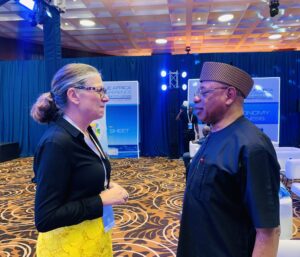
Bjerrum also pointed to the growing role of digitalisation in transforming the maritime value chain, noting that the emergence of new digital companies and the transition from manual to digital processes could improve efficiency and drive innovation across the sector. She stressed the need for stakeholders to adopt a full value-chain approach to maritime development and use platforms such as the Blue Africa Conference to build partnerships and develop practical solutions to the challenges confronting the industry. According to her, the focus should be on identifying what stakeholders can achieve together, who needs to be involved and how projects can be financed.
She further advocated starting with feasibility studies and pilot projects before moving to large scale investments, saying innovative ideas must first be tested and demonstrated before being expanded. Bjerrum emphasised that Nigeria’s maritime sector was important not only to the country but also to Denmark and the wider West African region.
Sierra Leone also called stronger regional collaboration to accelerate the development of Africa’s maritime sector, with the country pushing digitisation, port modernisation, sustainable fisheries and investment in ocean-based industries. Sierra Leone’s Minister of Transport and Aviation, Fande Turay, stressed that African ports could not realise their full potential in isolation, noting that efficient ports and seamless trade corridors would be critical to maximising the benefits of the African Continental Free Trade Area (AfCFTA).
Turay emphasised that infrastructure alone would not deliver Africa’s maritime ambitions, calling for greater investment in human capital, particularly maritime training and capacity development across the value chain. He also highlighted the importance of fisheries to national and regional economies, while warning that Illegal, unreported and unregulated fishing, marine pollution and weak environmental practices continued to threaten Africa’s marine resources and the sustainability of its blue economy.

He urged African governments and stakeholders to move beyond discussions and focus on developing bankable projects capable of attracting investors and development finance institutions. Sierra Leone, he said, was open to partnerships in port modernisation, sustainable fisheries, investment mobilisation and ocean based industries, while expressing the country’s readiness to work with Nigeria, MOWCA and other stakeholders to translate the outcomes of the Blue Africa Conference into concrete regional action.




One Comment