


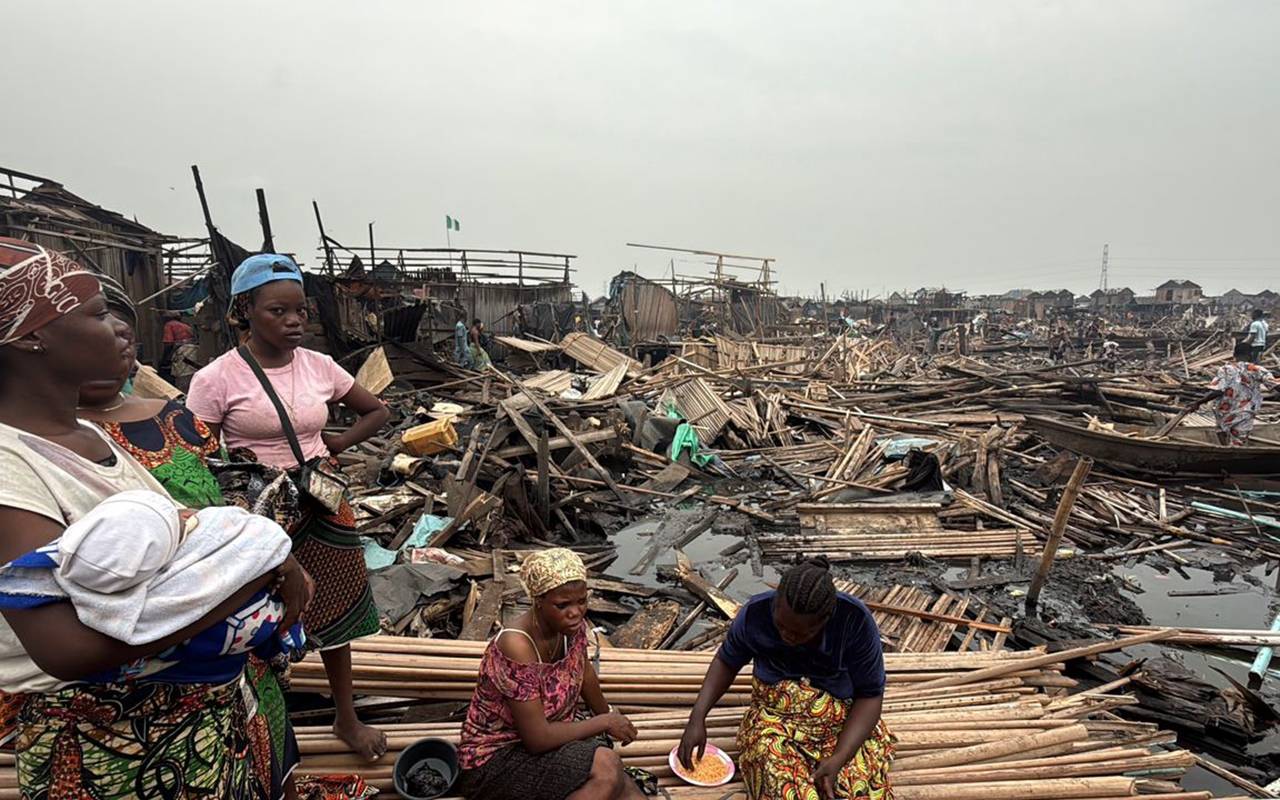
By early morning, the smoke still hung over Makoko. The smell of burnt wood mixed with lagoon water, and the cries of displaced families echoed across the waterfront.

Where homes once stood, there were now ashes, broken canoes, and frightened children clinging to their parents.
Human rights and environmental groups, the Centre for Children’s Health Education, Orientation and Protection (CEEHOPE) Nigeria, Health of Mother Earth Foundation (HOMEF), and Corporate Accountability and Public Participation Africa (CAPPA) say what is happening in Makoko is not just demolition; it is a humanitarian tragedy.
According to the groups, since January 5, 2026, armed men, security personnel, and demolition teams with bulldozers have repeatedly stormed Makoko, a historic fishing community on the Lagos Lagoon with over 100,000 residents.
Homes were allegedly set on fire, sometimes while people were still inside. Tear gas was fired at women, children, and elderly people. Many were injured and hospitalised.
So far, at least three people are reported dead – including two babies. Among the victims are 70-year-old Albertine Ojadikluno and a five-day-old baby, Epiphany Kpenassou Adingban.
More than 3,000 houses have reportedly been destroyed, forcing over 10,000 people out of their homes. Five schools, two clinics, and several churches and mosques are now rubble. Many families are sleeping in boats, churches, school buildings, or in the open, exposed to rain, cold, hunger, and disease.
The crisis deepened with the arrest of a community youth leader, Mr. Oluwatobi Aide, also known as Woli. Eyewitnesses say he approached demolition officials peacefully, begging for a few hours so residents could at least remove their belongings after the exercise spread beyond the area earlier announced by government officials.
Instead of listening, security agents arrested him on Monday, January 12, 2026. He was first taken to the Rapid Response Squad office in Alausa and later moved to Area F Police Station in Ikeja.
The groups say Mr. Aide had already been tear-gassed during earlier demolitions, was hospitalised, and his health has worsened in detention.
Condemning the situation, Nnimmo Bassey, Director of HOMEF, described the demolitions as a violent attack on the poor.
“These are the most violent signs of the Lagos State government’s contempt for the urban poor, whom it treats as human scrap to be cleared for elite profit. This land-grabbing and displacement is repugnant and must be stopped,” he said.

The groups also accused the government of changing its story. At first, officials claimed only buildings within 50 metres of power lines would be removed. Later, they said 100 metres. Yet demolitions have now reached areas like Oko-Baba, where there are no power lines at all.
“This shows that the real plan is to wipe out Makoko entirely,” said Akinbode Oluwafemi of CAPPA.
CEEHOPE’s Executive Director, Betty Abah, noted that Makoko is not alone. Over the past year, similar demolitions have taken place in Oko-Baba, Ayetoro, Otumara, Baba-Ijora, Oworonshoki, and other low-income communities. Many of these evictions happened without notice, consultation, compensation, or alternative housing.
She reminded Nigerians that communities like Badia East, Otodo-Gbame, Maroko, and Ilaje-Bariga have suffered similar fates in the past – leaving women and children especially vulnerable to hunger, violence, and extreme poverty.
The groups insist the demolitions are unconstitutional and violate Nigerian law, the African Charter on Human and Peoples’ Rights, and international standards that forbid forced evictions without due process.
They are demanding:
An immediate stop to all demolitions in Makoko and other communities.
The unconditional release of Mr. Oluwatobi Aide and others arrested for peaceful advocacy.

An independent investigation into the deaths and use of force.
Compensation, resettlement, and rebuilding of destroyed schools, clinics, and livelihoods.
Respect for courts, community dialogue, and due process.
“Urban development cannot be built on blood, fear, and homelessness,” the groups warned. “Destroying communities without humane alternatives will only deepen Lagos’s housing crisis and threaten social stability.”
As night falls again on Makoko, thousands of families have no roofs, no beds, and no certainty about tomorrow. What they ask for is simple: not luxury, not wealth – just the right to live, to be heard, and to be treated as human beings.







One Comment