

NSW: CRFFN Registrar, Igwe Pushes for Stakeholder Alignment as Project Goes Live
…announces Complaint and Feedback Portal


The Registrar of the Council for the Regulation of Freight Forwarding in Nigeria (CRFFN), Kingsley Igwe, has called for stronger collaboration among industry stakeholders as Nigeria’s National Single Window (NSW) goes live tomorrow,27th March 2026, with prospects of transforming trade facilitation across the country
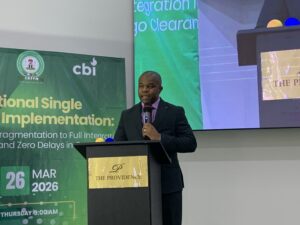
Speaking on Thursday, March 26, 2026, at the Stakeholders Engagement on the initiative and its Impact on End-to-End Trade Facilitation under the Marine and Blue Economy Agenda in Lagos, Igwe said the initiative represents a critical turning point for the freight forwarding industry.
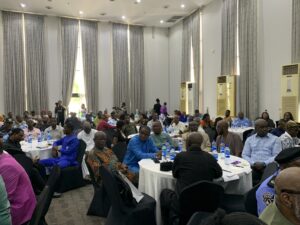
The event, themed “National Single Window Implementation: From Eliminating Fragmentation to Full Integration for Lower Trade Costs and Zero Delays in Cargo Clearance,” brought together government officials, industry leaders, and development partners to align on the implementation strategy of the NSW. Organised by the CRFFN, Maritime Anti-Corruption Network (MACN) and Convention on Business Integrity (CBi), Igwe described the engagement as timely and strategic, noting that it comes on the eve of the official launch of the NSW.
He also pointed to the deployment of digital platforms for registration, annual returns, and training, as well as the creation of a national freight forwarders registry to improve transparency and traceability within the sector.
According to him, the tripartite collaboration, known as the Integrity Alliance, was established in November 2025 to promote ethical practices and improve system accountability within freight forwarding operations, both within and outside the NSW framework. As part of ongoing reforms, Igwe announced the introduction of a Complaint and Feedback Portal, designed to enable freight forwarders and stakeholders to report inefficiencies, infractions, and operational bottlenecks in real time, strengthening regulatory oversight and ensuring that reforms translate into measurable improvements on the ground.
In her remarks, the Lead for West and Central Africa at the Maritime Anti-Corruption Network (MACN), Ms. Maria Gowon, emphasised that while new platforms are being introduced, the principles driving them are deeply rooted in ongoing reforms within Nigeria’s maritime sector. She explained that the engagement represents an evolution of a long standing collective effort toward integrity, efficiency, accountability, and transparency values that have continued to shape the sector over the years.
She highlighted that the timing of the engagement on the eve of the NSW launch reflects a shift toward inclusive reform where both the public and private sectors play active roles in shaping outcomes. Gowon emphasised the importance of digital tools in enhancing transparency, pointing out that the integration of the NSW with MACN and Convention on Business Integrity (CBi) reporting platforms would improve communication between stakeholders and regulators.
Highlighting the role of data, she explained that early reporting efforts in vessel operations, though initially fragmented, eventually evolved into a strong base of shared intelligence that informed reforms and strengthened engagement between industry players and authorities. She emphasized that without data there is no evidence, and without evidence there is no basis for reform.
Extending this principle to land based operations, Gowon encouraged freight forwarders and logistics professionals to report operational challenges, noting that such inputs are critical to identifying systemic issues and driving meaningful change.
In his keynote address, the Team Lead of the NSW Secretariat, Mr. Ayo Ojeniyi, representing the Director of NSW, Tola Fakolade, provided an in-depth overview of the initiative, highlighting the system’s purpose, progress, and immediate implementation plans. Ojeniyi noted that while the concept is not unique to Nigeria having first been implemented internationally in 1989 the country is now joining the growing group of nations that have domesticated the system for local use.

Ojeniyi highlighted the broad spectrum of stakeholders involved in the NSW, including private sector players such as importers, exporters, freight forwarders, shipping lines, airlines, and banks, as well as government agencies like the Nigerian Customs Service, Nigerian Ports Authority, Central Bank of Nigeria, NAFDAC, SON, and the Quarantine Service. He emphasised that the NSW is not intended to replace or override the functions of these agencies but to provide a collaborative platform that improves efficiency, reduces discretion in fee computation, and streamlines trade processes for all parties involved.
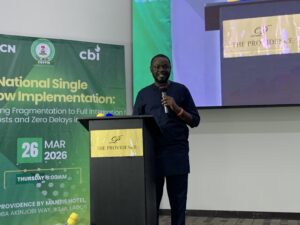

He detailed the structured rollout of the NSW in phases, beginning with Phase 1 Go-Live, which focuses on import-related licenses, permits, and certificates from agencies such as NAFDAC, SON, the Quarantine Service, and the relevant ministries. Manifest submissions will also be integrated within the next six to eight weeks through testing with selected shipping lines. Subsequent phases will expand coverage to exports, import duty exemption certificates, and eventually single sign on functionality for declarations, with the final goal of enabling end-to-end completion of trade processes on a single platform.
In his presentation, Mr. Soji Apampa, CEO of the Convention on Business Integrity (CBi), reflected on lessons Nigeria’s vessel clearance reform as a global model of collective action. He highlighted that the dramatic reduction in extortion cases from hundreds in 2019 to fewer than 30 in the most recent reporting cycle saved over $300,000 in one instance alone. Apampa emphasised that this progress was not achieved by a single agency or individual, but through collaboration among diverse stakeholders, unions, and government power blocs at the highest levels.
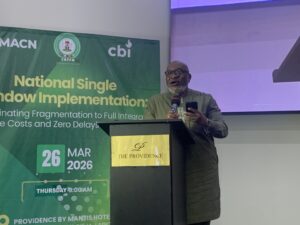
A central focus of his presentation was the adoption of digital reporting and data tools to drive transparency and informed decision making. Participants were introduced to SOP toolkits and user experience diaries accessible via QR codes, which allow stakeholders to document processes, report challenges, and generate verifiable evidence. Apampa explained that when the entire ecosystem participates, data becomes undeniable, turning complaints into actionable insights. He made a call for unity, urging stakeholders to adopt the Integrity Alliance platform and tools to build enforceable standards, credible advocacy, and a transparent, efficient, and globally competitive cargo clearance system.






One Comment