
The Nigeria Customs Service has approved the full automation of the Licences and Permits processes of the Service which is a direct response to the long-standing need to make its processes faster, more transparent, and easier for stakeholders.
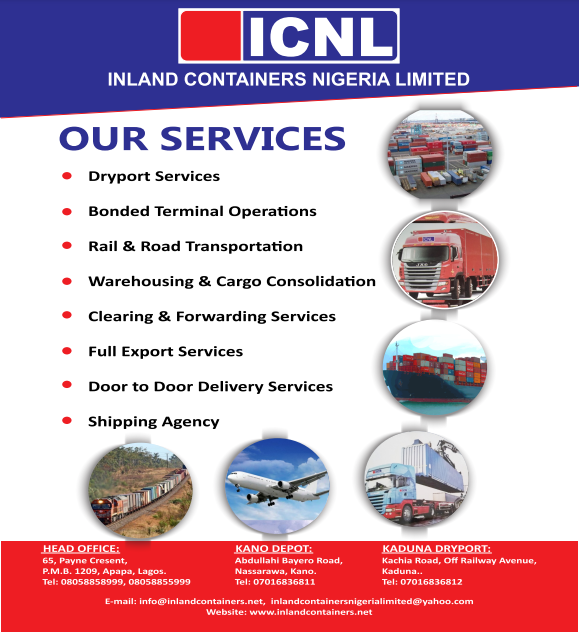
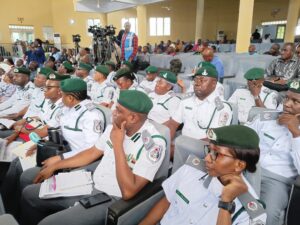
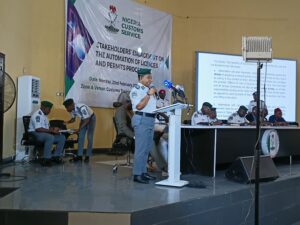
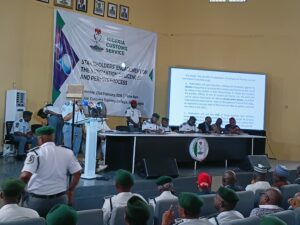
Speaking during the Zonal Sensitisation Programme for Zone ‘A’ , which was held on Monday 23rd February, 2026 at the Customs Training College Auditorium, Ikeja, Lagos, the Zonal Coordinator, Zone ‘A’, Mohammed Babandede who served as the Special Guest of Honour said for many years, stakeholders have had to deal with paperwork, long queues, and the uncertainty that comes with manual processing and those days are coming to an end.
He explained that the approval of full automation by the Comptroller-General of Customs, Bashir Adewale Adeniyi is a response to longstanding challenges associated with manual processing.
According to him, the sensitisation exercise, which is being conducted across all Customs zones nationwide, is designed to ensure that stakeholders are well acquainted with the new automated system before its full implementation.
Babandede stated that under the new system, applicants would be able to apply for and renew licences and permits online without visiting Customs offices, adding that the platform would allow users to track their applications in real time. He noted that automation would also guarantee uniformity, fairness and consistency in processing while reducing errors associated with manual records.
He further said the digital platform would enhance record-keeping, supervision and service delivery within the Service, enabling officers to attend to more stakeholders efficiently without increasing operational burdens.
Babandede described Zone ‘A’ as the most economically active Customs zone in the country, noting that Lagos remains Nigeria’s commercial hub and accounts for a significant volume of trade activities. He said the successful implementation of the automated system in the zone would set the pace for effective service delivery nationwide.

He reaffirmed the commitment of the Nigeria Customs Service to improving service delivery to Nigeria’s trade community, describing the automation initiative as part of broader efforts to transform Customs operations in line with global best practices.
“For Stakeholders, automation means that you will no longer have to go to a Customs office simply to apply for or renew a licence or permit. You will be able to do this from your office or even from your phone.
“It means your applications will be processed faster and you will be able to track the status of your application in real time. It also means that the process will be the same for everyone , fair, consistent, and without the risk of error that comes with manual records.
While delivering her welcome address, the Comptroller in charge of the Licences and Permits Unit, Tariff and Trade Department, Ngozika Anozie, said the ongoing automation of licences and permits processing will significantly reduce the cost of doing business, eliminate manual bottlenecks and improve transparency in Nigeria’s trade facilitation system.
She explained that the automation initiative is designed to simplify procedures for companies seeking fresh licences or renewals, while strengthening compliance, safety, and revenue generation for government.
According to her, companies will no longer need to travel repeatedly to customs offices or incur transport, accommodation and feeding costs just to process licences and permits, as applications can now be completed online.
Anozie noted that the digital platform will also help to curb sharp practices, as uploaded documents will be automatically screened to detect fake submissions, while genuine documents will be validated within the system.
She added that the system allows proper assessment of companies applying for licences or renewals, ensuring that only compliant firms are approved.
She stressed that automation will also boost statutory revenue generation, as every licence and permit issued is now integrated into the customs clearance process, making imports traceable to duly licensed companies.
She assured that customs officers and stakeholders have been trained on the new platform and that support teams are available to guide applicants through the step-by-step procedures, adding that the automation process is simple, seamless and user-friendly.
The Comptroller reaffirmed the commitment of the Nigeria Customs Service to trade facilitation, ease of doing business and improved service delivery through digital transformation of its operations.
“Automation will cut the cost of doing business and reduce movement risks for our stakeholders. Applicants will no longer need to shuttle between offices or cities to obtain or renew licences and permits.
“The more licences and permits we issue or renew, the more revenue accrues to government. Automation enhances efficiency, productivity and transparency in the system,” she said.





One Comment