


Maritime stakeholders have raised strong objections to plans by shipping companies to introduce another round of increases in port and shipping charges, warning that the move would further compound the economic hardship faced by Nigerians.
Speaking during a meeting with journalists, the Western Zone Coordinator of the Association of Nigerian Licensed Customs Agents (ANLCA), Mr. Femi Anifowose, linked the proposed hike to ongoing discussions around new tax policies and the implementation of the National Single Window, accusing shipping companies of exploiting the situation to impose additional financial burdens on importers and port users.
Anifowose noted that Nigeria remains largely import-dependent, with an estimated 70 per cent of goods consumed in the country sourced from abroad, stressing that any increase in shipping and terminal charges would inevitably be transferred to consumers through higher prices of goods and services nationwide.
He recalled that the last major increase in port-related charges occurred in 2023, shortly after the inauguration of the current administration, when shipping companies raised tariffs by as much as 400 per cent.
According to him, the operators had justified the hike at the time by citing exchange-rate volatility, high diesel prices and infrastructure maintenance costs. The increment, he said, was only moderated following sustained pressure from industry stakeholders.
However, Anifowose argued that prevailing economic conditions no longer justify another increase, noting that the exchange rate has stabilised and diesel prices have declined significantly, resulting in lower operational costs for shipping companies.
“What justification is there for another increase now?” he asked. “Rather than reducing charges in line with improved economic indicators, operators are proposing fresh increments.”
He also expressed concern over the role of the Nigerian Shippers’ Council, the sector’s economic regulator.
Anifowose alleged that shipping companies could not have advanced plans for new charges without prior engagement with the Council, while also criticising the Ministry of Marine and Blue Economy for what he described as its silence on issues affecting port users and maritime workers, including alleged harassment by security agencies.
He further questioned reports that letters were being issued to shipping companies through the Shippers’ Council by maritime police authorities, describing such actions as inappropriate and capable of undermining regulatory neutrality.
According to him, shipping companies are reportedly planning to implement the new charges as early as January 1, allegedly using anticipated tax adjustments as justification.

 The meeting, scheduled for December 30, 2025, he said, took place when most offices were operating at skeletal levels, with even the Nigerian Shippers’ Council and Maritime House largely deserted.
“The intention was clearly to ensure minimal attendance and later claim that stakeholders were consulted,” he alleged.
He noted that only a handful of persons attended the meeting, adding that available video evidence shows that those present were not representative of the maritime industry.
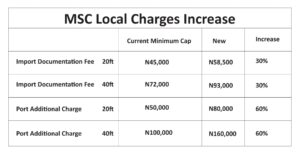
Despite this, MSC reportedly announced fresh increases ranging between 30 per cent and 60 per cent, to take effect from January 1, without what stakeholders described as due process or broad consultation.
The ANLCA coordinator also highlighted unresolved operational challenges, including delayed refunds of container deposits.
He disclosed that in his personal case, refunds for three to four containers paid to MSC had been pending for over three months, despite having official case numbers.
“These funds are being held without justification, allowing shipping companies to trade with other people’s money,” he said.
He further lamented worsening port congestion across major corridors such as Aba, Tin Can Island and Coconut axis, where trucks are now being used as holding bays due to overcrowded terminals and refusal to accept empty containers for certain shipping lines.
According to him, vessels arrive Nigerian ports with between 600 and 1,000 TEUs but depart with far fewer empty containers, while diverting others to neighbouring ports such as Lomé, creating artificial shortages and exacerbating congestion.
Anifowose described the proposed increments as exploitative, coming amid unresolved issues including port congestion, empty container shortages, delayed refunds and poor truck access.
He called on the Federal Government to urgently investigate the activities of shipping companies operating under the Ministry of Marine and Blue Economy, stressing the need for transparency, accountability and protection of industry stakeholders.
“We are not troublemakers,” he said. “We are job creators, job seekers and contributors to the national economy. Any policy that deepens hardship must be reviewed in the interest of the Nigerian people.”






One Comment